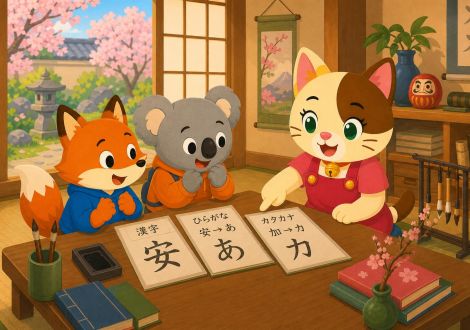
Kun'yomi and on'yomi are the two main ways of reading or pronouncing kanji. The kun'yomi reading comes from native Japanese words, while on'yomi comes from Chinese pronunciations adapted to Japanese.
A single kanji can be pronounced in a number of ways; it all depends on the word it appears in.
The origins of kanji in Japan
Before the fourth century, Japanese did not yet have a widely developed writing system of its own. It was around this time that Chinese characters made their way to Japan through texts written in Chinese. They were initially used to convey official documents, knowledge, and content related to Buddhism.
The word kanji (漢字) literally means "Han characters," referring to China's Han dynasty (206 BCE-220 CE). Over time, the Japanese adapted these characters to their own language and incorporated them into their writing system. Today, Japan's official list of everyday kanji contains 2,136 characters.
The difference between kun'yomi and on'yomi
Although a kanji can have several readings, they aren't freely interchangeable. Each reading is used in particular words and contexts.
Kun'yomi (訓読み)
Kun'yomi is a kanji's native Japanese reading. When Japanese adopted Chinese characters, some of them were assigned to existing Japanese words with the same meaning.
For example:
| Japanese / Reading and rōmaji / Meaning |
|---|
|
山 【やま, yama】 Mountain |
|
雨 【あめ, ame】 Rain |
In both cases, the kanji is read using a native Japanese word.
On'yomi (音読み)
On'yomi readings come from Chinese pronunciations adapted to Japanese. They were borrowed at different periods in history and are common in words made up of several kanji, though they can also appear in other combinations.
For example:
| Japanese / Reading and rōmaji / Meaning |
|---|
|
火山 【かざん, kazan】 Volcano |
|
学校 【がっこう, gakkō】 School |
|
電話 【でんわ, denwa】 Telephone |
When do you use kun'yomi vs on'yomi?
As a starting point:
- Kun'yomi often applies to a kanji appearing on its own or followed by hiragana endings.
- On'yomi often applies to a word made up of several kanji.
These are patterns rather than hard and fast rules.
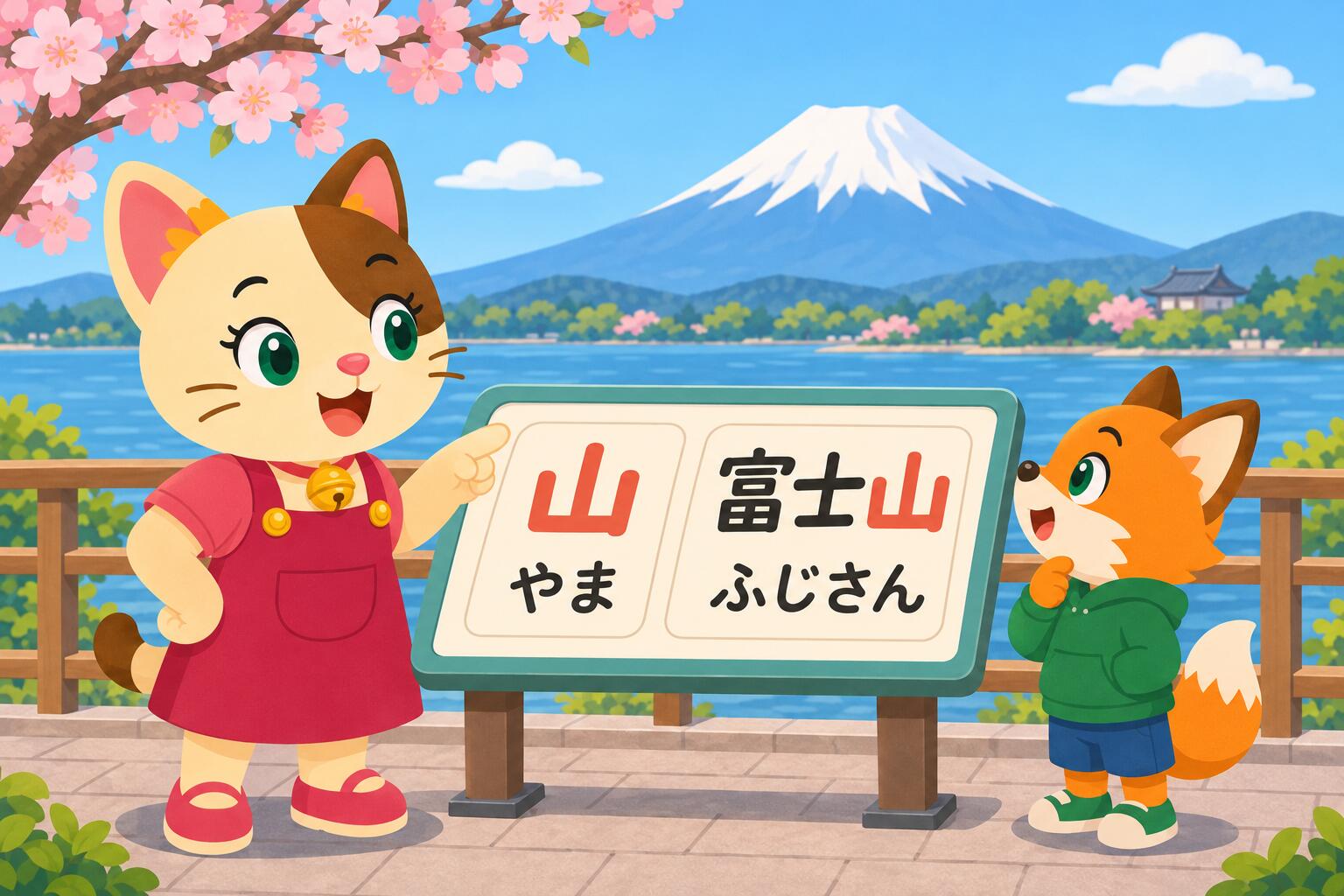
Let's look at the kanji 山, meaning "mountain."
When used on its own, it is usually read as:
| Japanese / Reading and rōmaji / Meaning |
|---|
|
山 【やま, yama】 Mountain |
This is its kun'yomi reading.
In the word 富士山【ふじさん, Fujisan】, meaning "Mount Fuji," however, the same kanji 山 is pronounced san. Here, san is an on'yomi reading of 山.
The character is the same, but its pronunciation changes depending on the word it appears in.
Some compound words also use kun'yomi readings.
Let's look at another example:
| Japanese / Reading and rōmaji / Meaning |
|---|
|
大 【おお, ō】 Big |
|
雨 【あめ, ame】 Rain |
Together, they form the word:
| Japanese / Reading and rōmaji / Meaning |
|---|
|
大雨 【おおあめ, ōame】 Heavy rain |
Here, both kanji use their kun'yomi readings: ō for 大 and ame for 雨.
You can see why the most reliable approach is to learn the reading along with the word.
At Khanji School, we learn kanji through words and examples in context. This helps us learn which reading each word uses, without having to memorize endless lists.
Frequently asked questions about kun'yomi and on'yomi
Do all kanji have both kun'yomi and on'yomi readings?
No. Many kanji have both types of reading, but others have only one or the other or have their own special readings.
Is on'yomi always used when two kanji appear together?
No. Although on'yomi readings are common in compound words, some combinations use kun'yomi, such as 大雨【おおあめ, ōame】, meaning "heavy rain."
How can I tell which reading to use for a kanji?
The most reliable approach is to learn the whole word, check a dictionary when needed, and pay attention to how it is used in context. General guidelines help, but there will always be exceptions.
|
Free download
If you've made it this far, you're serious. Turn that momentum into real progress with Chinesimple and make every study session count.
Native audio
Games
Flashcards
Exams
Pronunciation


|
|