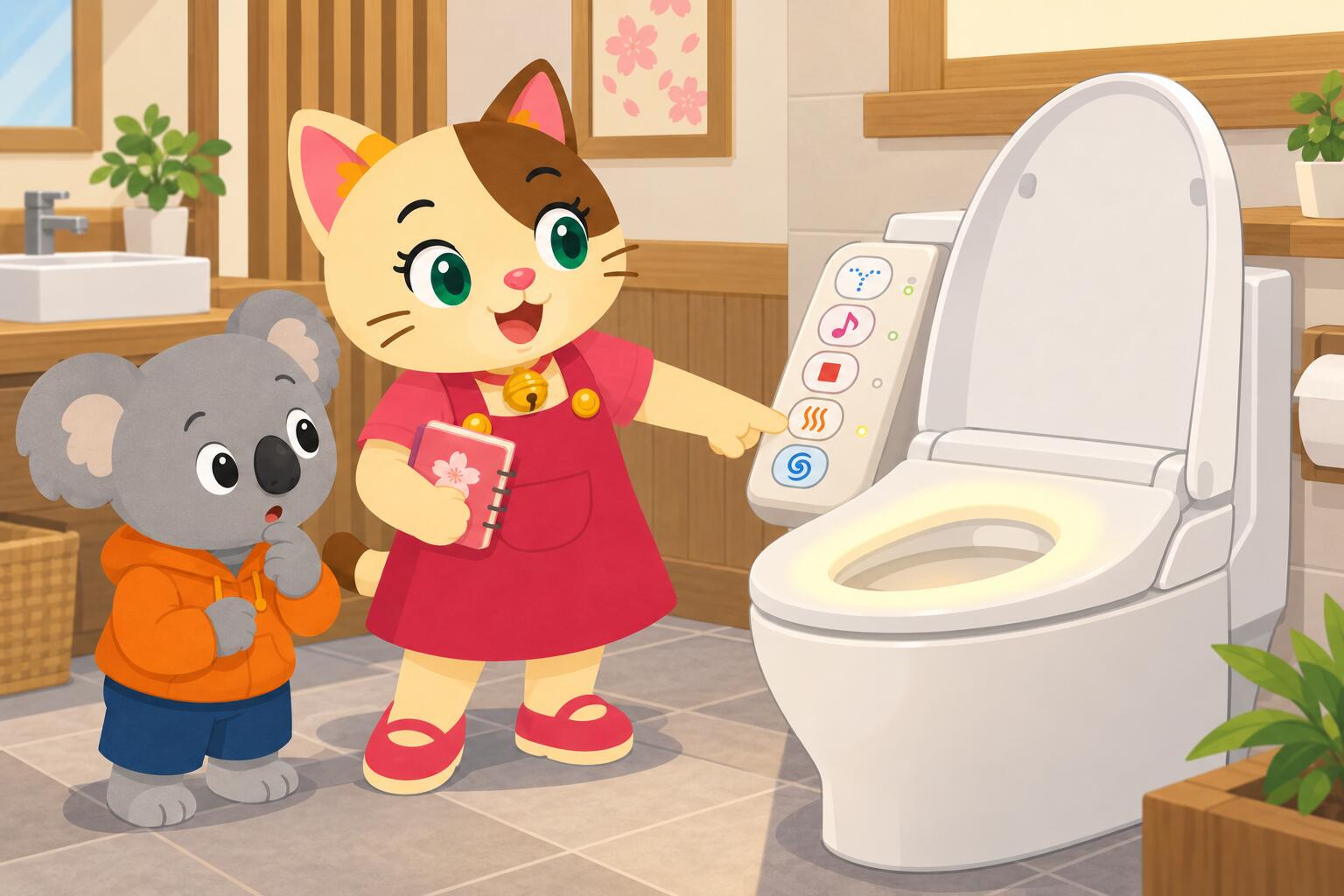
There are many things in Japan that might feel different from what we're used to elsewhere, and toilets are definitely one of them. Japanese toilets have changed a lot in recent years. Some now have so many features and controls that it can be hard to know which button to press – especially if you don't know Japanese.
The last time I went to Japan, a Western friend ran out of a public restroom and asked me, "How do I flush this?" No wonder: there were so many buttons, and the labels are often only in Japanese.
In the past, traditional squat toilets were common in Japan. You can still find them today, but not so much in modern public restrooms.
So, if you're traveling to Japan, knowing a few toilet-related words can be very useful. At Khanji School, we also focus on practical vocabulary like this, i.e. words you may encounter in real-life situations.
What do the buttons on a Japanese toilet mean?
Here are some of the buttons and words you might find on a Japanese toilet:
ビデ【bide】bidet
Front wash: a stream of water for cleaning the front area after using the toilet.
おしり【oshiri】rear
Rear wash: a stream of water for cleaning the rear area.
乾燥【かんそう, kansō】drying
Uses warm air to dry you after washing.
停止【ていし, teishi】stop
Stops the water spray or any other active function.
水勢【すいせい, suisei】water pressure
Lets you adjust the water pressure.
ノズル【nozuru】nozzle
Refers to the washing nozzle. Depending on the model, you might be able to adjust its position or clean it.
脱臭【だっしゅう, dasshū】deodorizer
Turns on a ventilation or filtration system to reduce odors.
音姫【おとひめ, otohime】privacy sound
Plays the sound of running water to mask other restroom noises.
Interestingly, 音【おと, oto】means "sound" and 姫【ひめ, hime】means "princess." So it literally means "sound princess."
流す【ながす, nagasu】flush
This can mean "to let flow," "to move something along," or "to flush." On a toilet, it means the latter. In some restrooms, the flush button is on the wall or beside the toilet rather than on the toilet itself.
You may also find:
- 大【だい, dai】full flush, which uses more water.
- 小【しょう, shō】light flush, which uses less water.
自動洗浄【じどうせんじょう, jidō senjō】automatic function
Depending on the model, this may refer to automatic flushing or another automatic cleaning function.
便座【べんざ, benza】toilet seat
This means "toilet seat" and may appear alongside options for seat temperature or seat opening and closing, depending on the model.
温度【おんど, ondo】temperature
You may see this word on temperature controls.
Depending on the model, you can use it to adjust the water and seat temperatures.
The heated seat is my favorite feature – especially in winter.
On a cold day in Japan, a warm toilet seat can be a small but very pleasant surprise.
What about you? Which feature would be your favorite?
Frequently asked questions about Japanese toilets
Do all toilets in Japan have that many buttons?
No. It depends on where you are and on the model. Some are very simple, while others have many functions.
Which button should I press to flush in Japan?
Look for 流す【ながす, nagasu】, which means "flush" in this context. Some toilets also have 大【だい, dai】and 小【しょう, shō】buttons for a full vs light flush.
What should I do if I press the wrong button?
If you start a wash function by accident, just press 停止【ていし, teishi】to stop it.
|
Free download
If you've made it this far, you're serious. Turn that momentum into real progress with Chinesimple and make every study session count.
Native audio
Games
Flashcards
Exams
Pronunciation


|
|