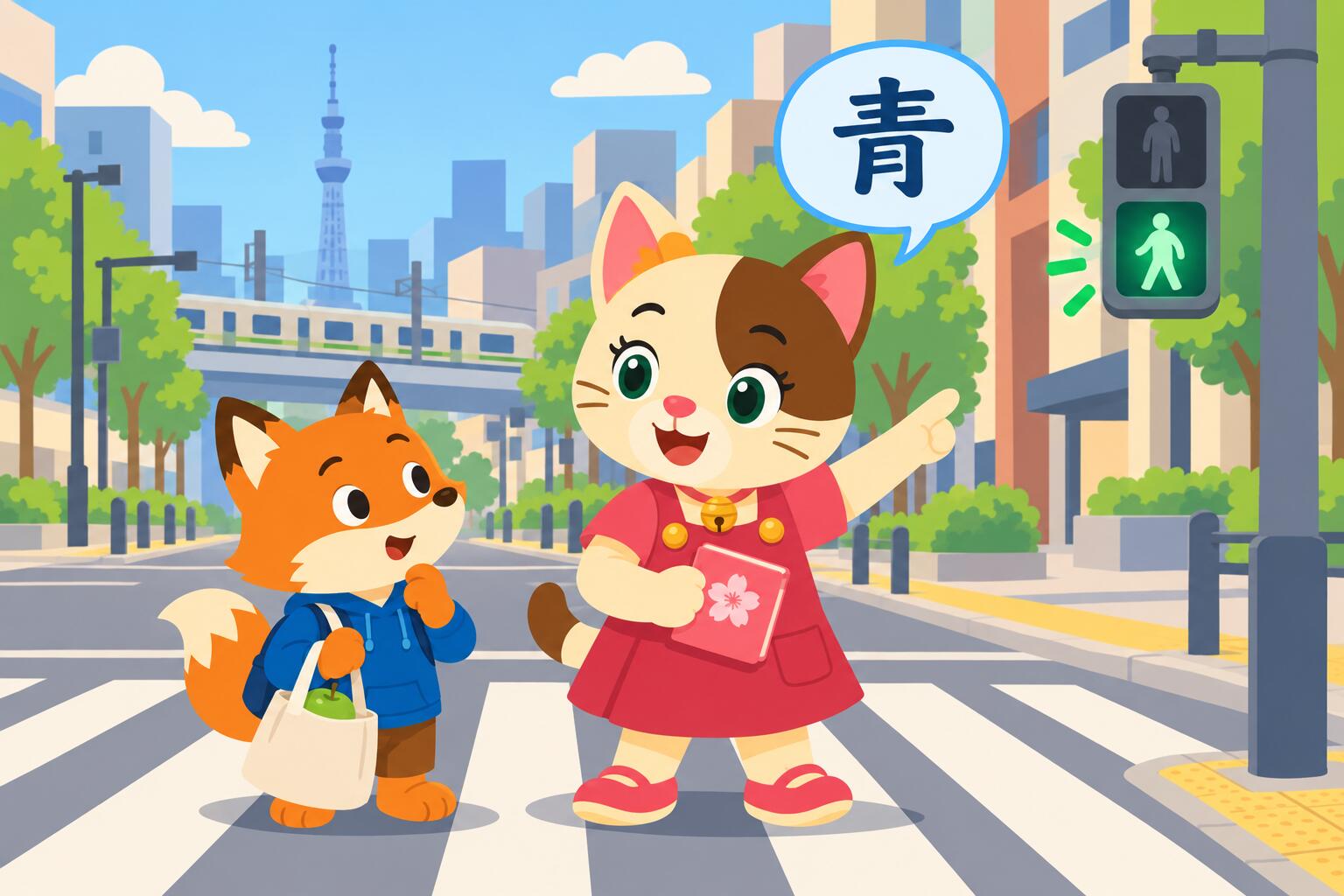
In a word, yes. In Japan, we sometimes use 青【あお, ao】, which usually means "blue," for things that many other languages would call green. It's not that we can't tell green from blue; some of our expressions simply use an older definition of 青.
To put it into context, let me tell you about a funny language mix-up from my first year in Europe...
Is there such a thing as a "blue" traffic light?
One time, I was out for a walk around the neighborhood with a European friend. We were waiting at a traffic light. When it changed, I said:
"Let's go, it's turned blue."
My friend looked at me in surprise and said:
"Blue?!"
I couldn't understand her confusion, so I insisted:
"Yes, it was red before, and now it's blue."
She was just as persistent and asked:
"What do you mean, 'blue'?"
That was when I realized why she was so surprised. To me, saying that the light had turned "blue" felt completely normal.
Do Japanese people ever confuse green and blue?
No. Don't worry, we can tell green and blue apart. The explanation lies in the history of the Japanese language. Historically, 青【あお, ao】 referred to a wider range of colors, including shades we would now describe as green or blue. Over time, 緑【みどり, midori】 established itself as the specific word for green.
But some older Japanese expressions have survived, and we still use them today. So although we usually use 緑【みどり, midori】 for green, we still use 青【あお, ao】 in certain contexts.
So, when is "blue" used for something that is green?
Two familiar examples are traffic lights and unripe fruit.
Traffic lights
In Japanese, we call a green traffic light 青信号【あおしんごう, ao shingō】, literally "blue traffic light." For example:
| Japanese / romaji / meaning |
|---|
| 青信号になった。 【Ao shingō ni natta.】 This means "The light has turned green." |
It's one of those examples where a literal translation would sound a little strange.
Unripe fruit
The adjective 青い【あおい, aoi】 can also describe fruit that is not ripe yet.
For example:
| Japanese / romaji / meaning |
|---|
| そのりんごはまだ青い。 【Sono ringo wa mada aoi.】 If we translated 青い simply as "blue," it would read "That apple is still blue." Here, it actually means: "That apple isn't ripe yet." |
This phrase holds on to the older idea of 青 as a broader color category.
Can "blue" be used to describe an inexperienced person in Japanese?
Yes. This is another interesting use.
For example:
| Japanese / romaji / meaning |
|---|
| お前はまだ青いな。 【Omae wa mada aoi na.】 If we translated 青い simply as "blue," this would read "You're still blue." |
Here, we're not saying someone looks sad. This phrase actually has the same meaning as "You're still green" in English. In other words, you're inexperienced or naive.
Watch out with this one, though. This sentence can sound blunt or dismissive in the wrong context. お前【おまえ, omae】 is a very informal way of saying "you" and can sound rude depending on who you are talking to.
So, how do you say "green" in Japanese?
In modern Japanese, we usually use 緑【みどり, midori】 to mean "green."
For example:
| Japanese / romaji / meaning |
|---|
| 緑の車 【midori no kuruma】 "A green car." |
Even so, 青【あお, ao】 is still used in some contexts that reflect its older, broader meaning.
That's something I find particularly fascinating about Japanese: words don't just change their meaning overnight. Older definitions can survive for centuries in expressions that we still use today.
Learning Japanese is not just about memorizing that 緑 means "green" and 青 means "blue." To really understand the language, we also need to explore the history of words and expressions, how they are used, and the contexts in which they appear. At Khanji School, we learn Japanese by exploring these connections in addition to memorizing vocabulary.
Frequently asked questions
Do Japanese people call green "blue"?
Not exactly. In modern Japanese, 緑【みどり, midori】 means "green" and 青【あお, ao】 means "blue." However, some traditional expressions still use 青 for things that many other languages would consider green.
Is a green traffic light called "blue" in Japanese?
Yes. It is common to say 青信号【あおしんごう, ao shingō】, literally "blue traffic light," to refer to a green traffic light.
Why can an unripe apple be described as "blue" in Japanese?
Because 青い【あおい, aoi】 can describe fruit that has not ripened yet. For example, そのりんごはまだ青い。【Sono ringo wa mada aoi.】 means that the apple is not ripe yet.
What does 青い【あおい, aoi】 mean when describing a person?
It can mean that someone is still inexperienced or naive. For example, お前はまだ青いな。【Omae wa mada aoi na.】 can suggest that a person still has a lot to learn. However, お前 is very informal and may sound blunt depending on the context, so be careful how you use it!
|
Free download
If you've made it this far, you're serious. Turn that momentum into real progress with Chinesimple and make every study session count.
Native audio
Games
Flashcards
Exams
Pronunciation


|
|