Japanese is a highly visual language. The written form uses kanji to express the meaning of words that sound the same and help distinguish between them.
When you first start learning Japanese, one of the biggest surprises is that some words can sound exactly the same yet have completely different meanings. Kanji help make these differences immediately clear.
How do kanji make Japanese easier to understand?
Japanese has many homophones: words that are pronounced the same but have different meanings.
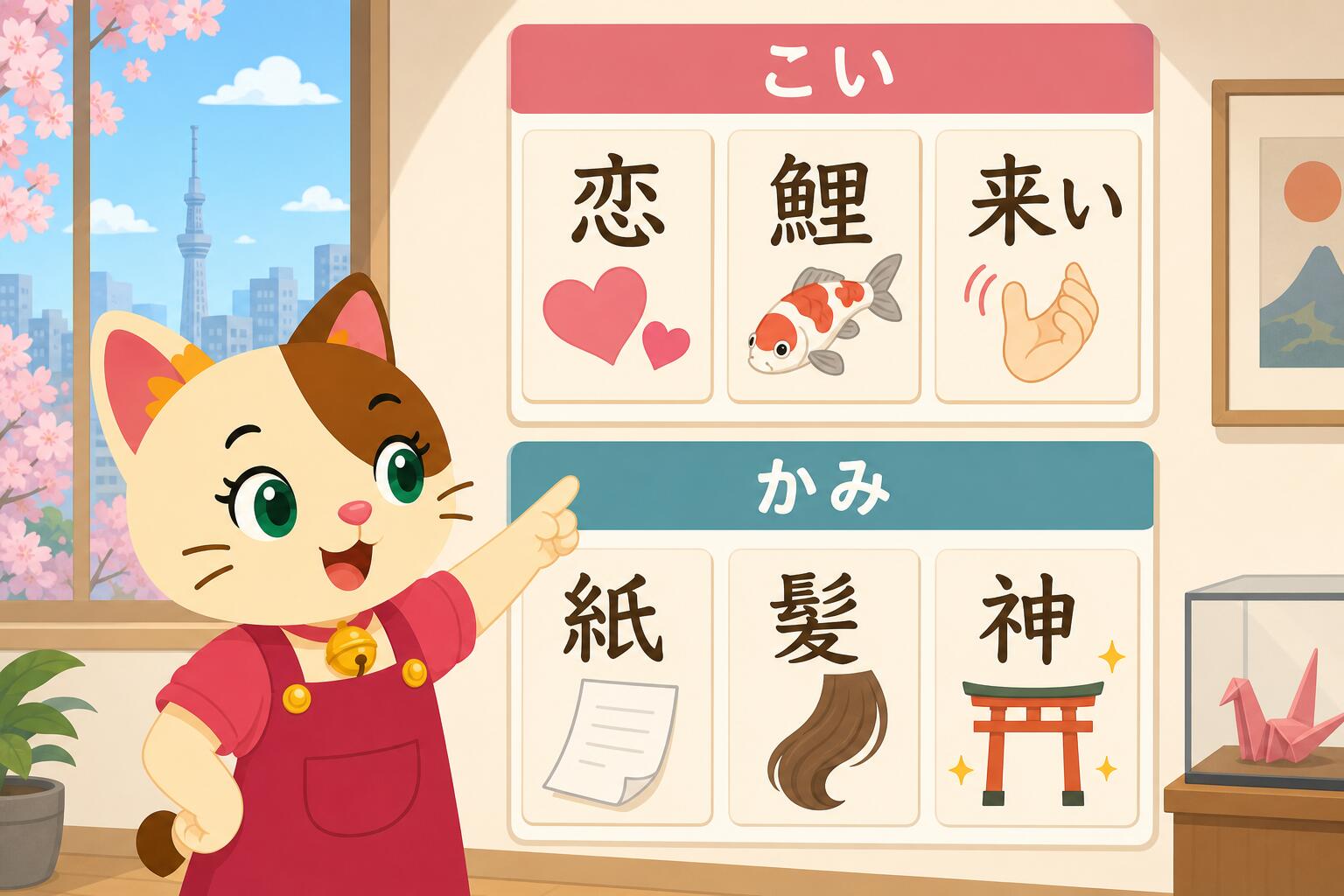
For example, こい【koi】 can refer to a number of things depending on how it is written:
- 恋: being in love; romantic love
- 鯉: carp
- 来い: “Come!” – the imperative form of the verb “to come”
- 故意: deliberate intent; when followed by に, “deliberately” or “on purpose”
- 濃い: strong, thick or concentrated
When speaking or listening to Japanese, context is hugely helpful in identifying the intended meaning. In writing, kanji make the distinction much clearer.
Another example is かみ【kami】:
- 紙: paper
- 髪: hair
- 神: god or deity
These words are all pronounced the same, as “kami”, but are written differently, so you can tell the difference. You see, learning kanji is not just about memorizing characters: it can actually help you better understand the meaning of Japanese words.
How come different surnames have the same pronunciation?
Kanji are especially interesting when it comes to Japanese names. The same surname can be written in several different ways.
For example, the surname Abe may be written as:
- 阿部
- 安部
- 安倍
- 阿倍
Another example is Saitō, which is commonly written using one of these variants:
- 斎藤
- 斉藤
- 齋藤
- 齊藤
Other, much less common spellings also exist, and some surnames can have more than one reading. Knowing how a surname is pronounced is not always enough to know which kanji are used to write it down!
Why do Japanese people ask which kanji are used to spell a name?
When meeting someone new in Japan, it’s quite common to ask which kanji are used to spell their name. This is not just down to a national love of spelling: names can be quite unpredictable, and the chosen kanji can even symbolise ideas such as nature, beauty, intelligence, strength, or happiness.
What can kanji tell us about Japanese culture?
Kanji do so much more than just represent words. They connect sound, meaning, and the written form: the same pronunciation can have a number of different meanings – kanji provide a wealth of information to help you decipher which one. This relationship is one of the most fascinating parts of learning Japanese.
With Khanji School, learning kanji is more than just memorizing lists of characters in isolation. It’s about understanding what they mean and seeing how they are used in words and names so that you can start reading Japanese more fluently.
Frequently asked questions about Japanese kanji
Can the same pronunciation be written using different kanji?
Yes. Many words are pronounced the same but written using different kanji and have different meanings. For example, kami can mean 紙 (paper), 髪 (hair), or 神 (god).
How do Japanese speakers identify the meaning of homophones when they hear them?
Context is key. The conversation, the situation, and the words surrounding the homophone make its intended meaning clear.
Does every Japanese surname have only one spelling?
No. Some surnames can be written with several different combinations of kanji, and the same written form can also have different readings. That’s why it is common for Japanese speakers to check which kanji make up a person’s surname.
Do I need to learn every kanji before I start studying Japanese?
No, it’s a gradual process. The important thing is to study kanji as they appear in real words and contexts, so you’re not just memorizing a list of characters.
|
Free download
If you've made it this far, you're serious. Turn that momentum into real progress with Chinesimple and make every study session count.
Native audio
Games
Flashcards
Exams
Pronunciation


|
|