Hiragana and katakana are two of the three writing systems used in Japanese, the third being kanji. Although they are now taught very early on in Japanese lessons, both originated more than a thousand years ago from Chinese characters and, more specifically, from the need to adapt Chinese writing to the Japanese language.
What are hiragana and katakana?
Hiragana and katakana are two Japanese syllabaries, a system where each character represents a sound. Together with kanji, they form the foundation of the Japanese writing system.
In this article, we will focus on their historical origin. If you would like to understand the linguistic differences between hiragana, katakana and kanji before you dive in, you can read our guide to the Japanese writing systems.
The origin of katakana
At the beginning of the Heian period, in the first half of the 9th century, Buddhist monks and Japanese scholars studied a large number of texts written in Classical Chinese. Many of these texts related to Buddhism and to the academic knowledge brought over from China.
The only problem was that Classical Chinese and Japanese had very different grammatical structures. The natural word order of Japanese meant readers needed to add small annotations between the lines (reading marks, particles, grammatical endings and other notes) to help properly interpret the text.
But space was extremely limited. It just wasn’t practical to try and fit full Chinese characters in the narrow margins of manuscripts. That’s how people began to abbreviate their annotations, using only part of certain kanji.
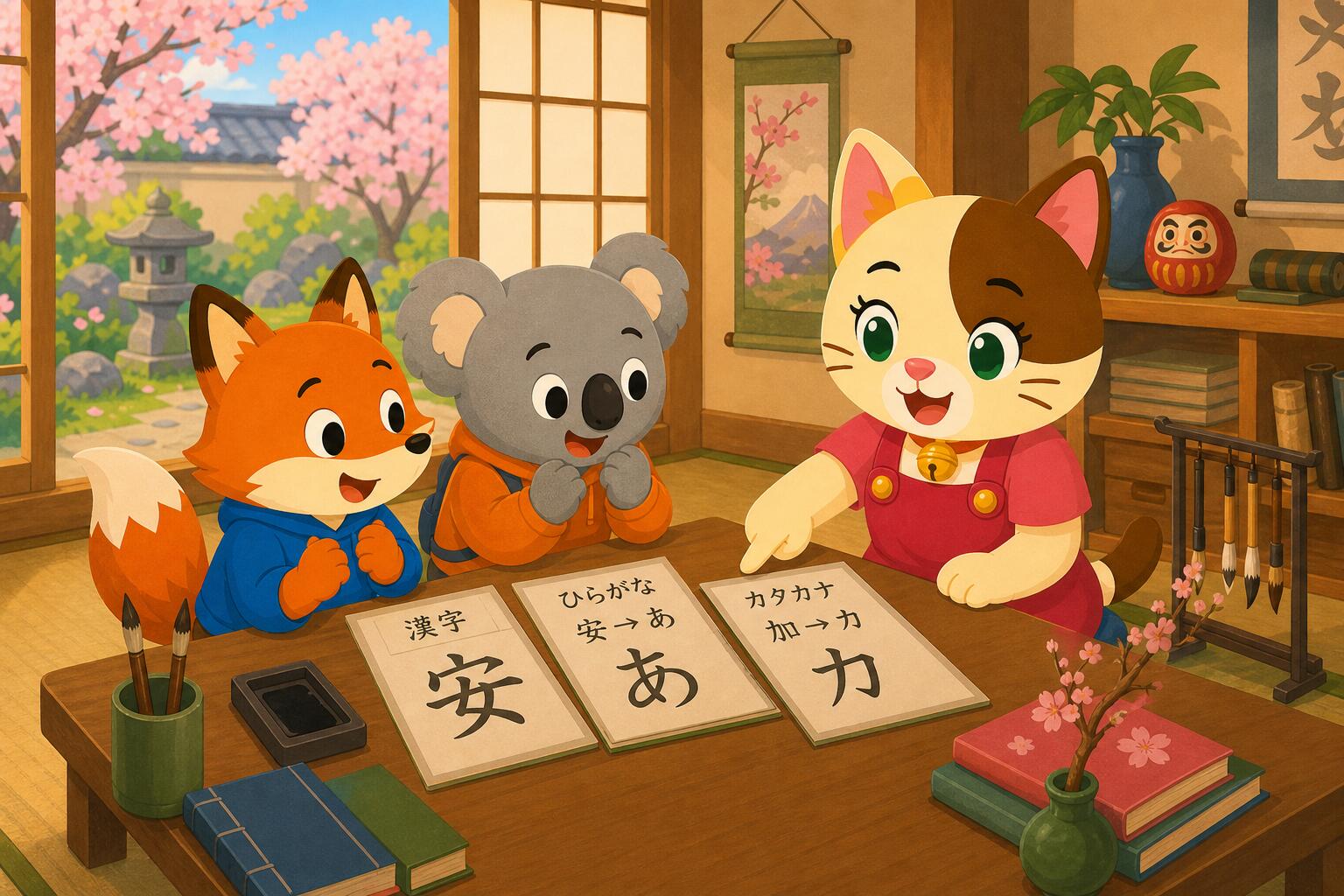
And so, the prototype of modern katakana was born! In fact, the word katakana literally means “fragmentary kana”, since many of its characters come from fragments of more complex kanji. This practical origin means their shapes are simpler, straighter and more angular, because they were designed to be written quickly and clearly as a reading aid.
The origin of hiragana
Hiragana also appeared during the Heian period, but a little later and in a very different context: that of the cultural and literary life of the imperial court.
At that time, the official written language was still Classical Chinese written with kanji. It was a rigid, prestigious form of writing used mainly by men in administrative, religious and academic contexts. However, this writing system was not the easiest or most natural way to express Japanese grammar, or to capture the subtle emotional nuances of poetry and literature.
From manyōgana, a system that used kanji for their phonetic value rather than their meaning, a more cursive, fluid and rounded writing style gradually began to emerge. For example, the character 「安」 eventually gave rise to 「あ」, which represents the “a” sound, while 「宇」 evolved into 「う」, the “u” sound.
This new form of writing became intrinsically linked with the private spaces of the court and with literature written by aristocratic women. Hence how hiragana earned the name onnade, “women’s hand”, in contrast to the official kanji-based writing style, otokode, “men’s hand”.
By the year 900, hiragana had already developed into a system capable of directly representing the sounds of Japanese. A particularly important example can be found in the kana preface to the Kokin Wakashū, the first major imperial anthology of Japanese poetry, compiled around 905.
Why is it important to learn hiragana and katakana?
Learning hiragana and katakana is one of the first steps in studying Japanese. You’ll need to master these two syllabaries before moving onto kanji, as they appear in almost every kind of Japanese text, from books, signs and menus to manga, apps, subtitles and websites.
Knowing their history also gives you a deeper understanding of the Japanese language. Hiragana and katakana are not simply alphabets: they are the result of centuries of cultural adaptation, contact with China and Japan’s own linguistic evolution.
At Khanji School, learning Japanese begins with understanding the ins and outs of its writing system. Because, behind every character, there is not just a sound, but a piece of Japan’s very history.
|
Free download
If you've made it this far, you're serious. Turn that momentum into real progress with Chinesimple and make every study session count.
Native audio
Games
Flashcards
Exams
Pronunciation


|
|