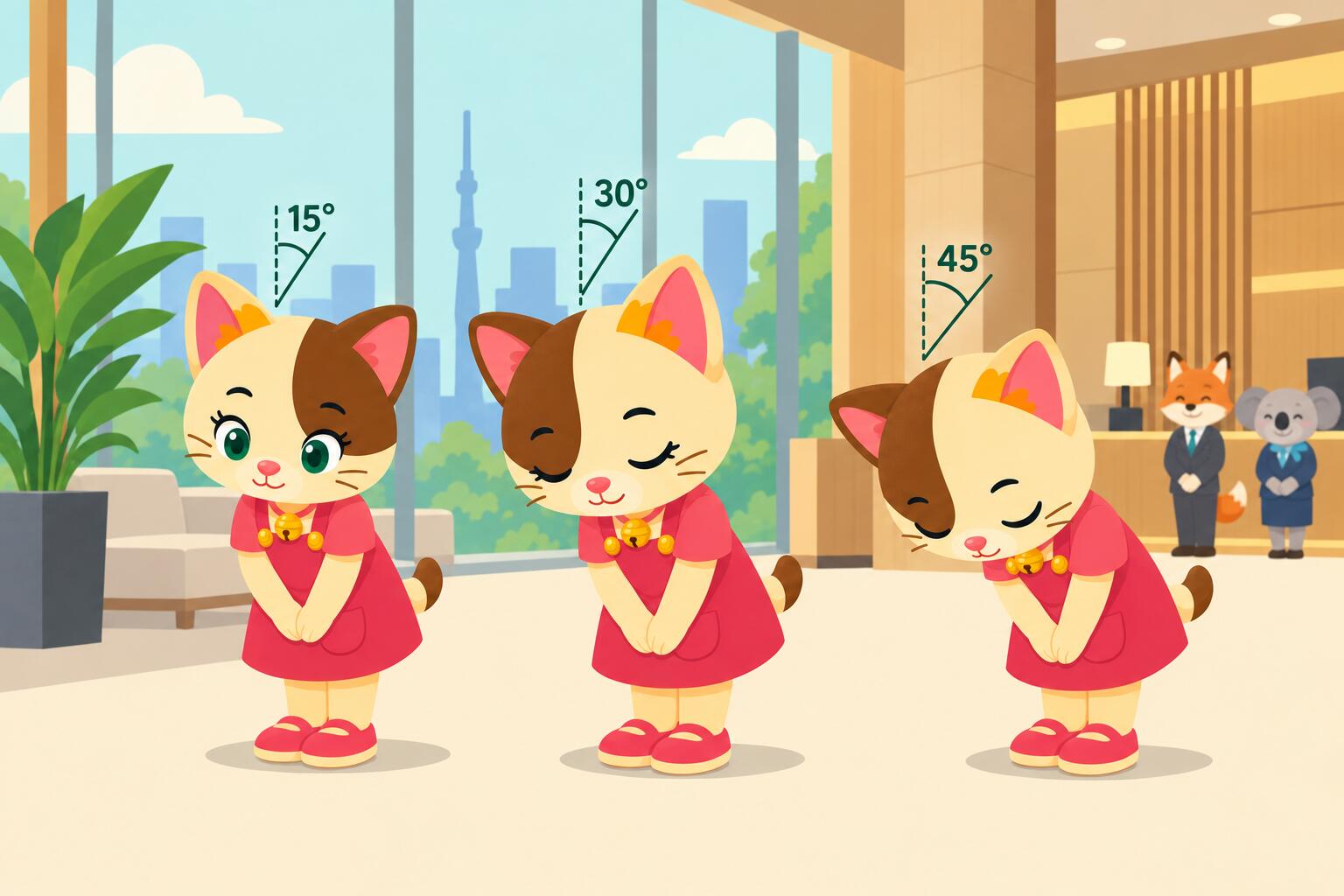
In Japan, the way you bow depends on the situation and the level of respect you want to show. As a general rule, the deeper the bow, the greater the respect: around 15 degrees for casual greetings, 30 degrees in formal situations, and 45 degrees to show the utmost respect, give thanks, or apologize. These angles are only guidelines: the depth and duration of a bow also depend on the context.
What are the most common bow angles used in Japan?
The angle you bow at can vary depending on the context, the company, or the etiquette being followed. As a general guide, Japanese etiquette usually recognizes three main types of bow:
会釈【えしゃく, eshaku】: a slight bow of around 15 degrees
This is used for casual greetings and situations that do not require a formal bow.
敬礼【けいれい, keirei】: a formal bow of around 30 degrees
This is one of the most common bows in formal situations.
It is used, for example, when introducing yourself, saying hello or goodbye to a customer, or saying thank you.
最敬礼【さいけいれい, saikeirei】: a deep bow of around 45 degrees
This type of bow is used to convey a serious apology, deep gratitude, or a great deal of respect.
Within this classification, a deeper bow generally conveys greater formality or respect and can express more earnest gratitude or apology. The duration of the bow and the relationship between the people involved are also key.
Are there even deeper bows?
In exceptional circumstances, a bow may be even deeper or held for longer. However, these deeper bows do not form part of the three common categories covered here and should not be treated as a fixed 90-degree type.
What is 土下座【どげざ, dogeza】?
土下座【どげざ, dogeza】 is an extreme gesture used to express a very serious apology, deep regret, or a desperate plea. It is not a normal part of everyday life in Japan.
土下座【どげざ, dogeza】 involves kneeling on the ground, placing both hands on the floor in front of you, and lowering your head deeply.
Depending on the context, 土下座【どげざ, dogeza】 can convey:
- an extreme apology or deep regret;
- a desperate plea;
- an exceptional show of deference.
For this reason, 土下座【どげざ, dogeza】 is not a response to an ordinary mistake. In everyday life in Japan, a verbal apology, a bow, or other forms of courtesy will usually suffice.
It's also important not to confuse it with a deep standing bow. Although both can express a very serious apology, 土下座【どげざ, dogeza】 involves kneeling and prostrating yourself on the ground, making it a far more extreme and exceptional gesture.
In anime, manga, and other forms of Japanese popular culture, 土下座【どげざ, dogeza】 can appear in dramatic or even comedic scenes, especially when a character wants to show how far they are willing to go to get what they want or to beg for forgiveness.
How do you bow correctly in Japan?
Bow from the waist, not the neck
When bowing, do not tilt your neck forward. Your back and neck should stay aligned, with your upper body bending at the waist.
Let your gaze follow the motion
Keep your head and neck aligned with your back, and let your gaze lower naturally as you bend your torso. The deeper the bow, the closer to your feet your gaze will naturally fall.
Should you speak before or after bowing?
In formal greetings, it is often recommended that you finish speaking before bowing so that you can be heard more clearly. However, the exact timing can vary depending on the situation and required workplace etiquette.
For example:
| Japanese / romaji / meaning |
|---|
| ありがとうございます。 【Arigatō gozaimasu.】 Thank you very much. |
In a formal greeting, you would finish the phrase and then bow.
Where should you place your hands when bowing?
Hand position varies depending on the context and the etiquette being followed.
In business etiquette, men commonly keep their hands at their sides. Women may place their left hand over their right in front of their body.
The most important thing is to maintain a natural, composed, and respectful posture.
Why is it important to learn how to bow properly?
Bowing is not just about bending your body. The angle, posture, gaze, hand position, and when you speak can all significantly affect the impression you make.
In Japan, we are raised to bow. When we join a company, especially in customer-facing roles, we may even receive training on how to bow properly. Learning these small details can help you better understand Japanese communication and manners.
At Khanji School, we learn Japanese alongside the cultural context of expressions and gestures such as bowing. Understanding how and when they are used can help you communicate more naturally in Japan.
Frequently asked questions about Japanese bowing
What do 15-, 30-, and 45-degree bows mean?
As a general guide, a bow of around 15 degrees is used for casual greetings, 30 degrees for formal situations, and 45 degrees to show the utmost respect, give thanks, or apologize. These angles are only guidelines and can vary depending on the context.
Should you speak before or after bowing?
With formal greetings, it is often recommended that you finish speaking before bowing so that you can be heard more clearly. However, the exact timing can vary depending on the situation and required workplace etiquette.
Where should you place your hands when bowing?
Hand position depends on the context and required etiquette. In professional situations, men usually keep their hands at their sides, while women may place their left hand over their right in front of their body.
What is 土下座【どげざ, dogeza】 and when is it used?
土下座【どげざ, dogeza】 involves kneeling on the ground, placing both hands on the floor in front of you, and lowering your head deeply. It is an extreme way to express an apology or regret, or to make a plea, and it is not common in everyday life.
What is the difference between a deep bow and 土下座【どげざ, dogeza】?
A deep bow is performed while standing and can convey a high degree of respect or a serious apology.
In contrast, 土下座【どげざ, dogeza】 involves kneeling and prostrating yourself on the ground. This makes it a much more extreme form of apology, regret, or plea, and it is not something people normally do in everyday life.
|
Free download
If you've made it this far, you're serious. Turn that momentum into real progress with Chinesimple and make every study session count.
Native audio
Games
Flashcards
Exams
Pronunciation


|
|