In this article, we look at the story behind the birth of Japan, as told by Japanese mythology: from Izanagi and Izanami to the creation of the islands, Yomi no Kuni, and the birth of Amaterasu.
The myth surrounding the birth of Japan is mainly found in two ancient texts: the Kojiki (古事記, "Record of Ancient Matters") and the Nihon Shoki (日本書紀, "Chronicles of Japan"). Read as a mythical narrative, it is an epic story about the creation of the Japanese islands, the birth of the gods, and the origins of the Japanese imperial family.
The birth of Japan begins with two gods
At the beginning of time, according to Japanese mythology, the world was still just a formless, ocean-like mass, with no terra firma to speak of. So, the gods instructed two divine siblings, Izanagi and Izanami, to create a new land.
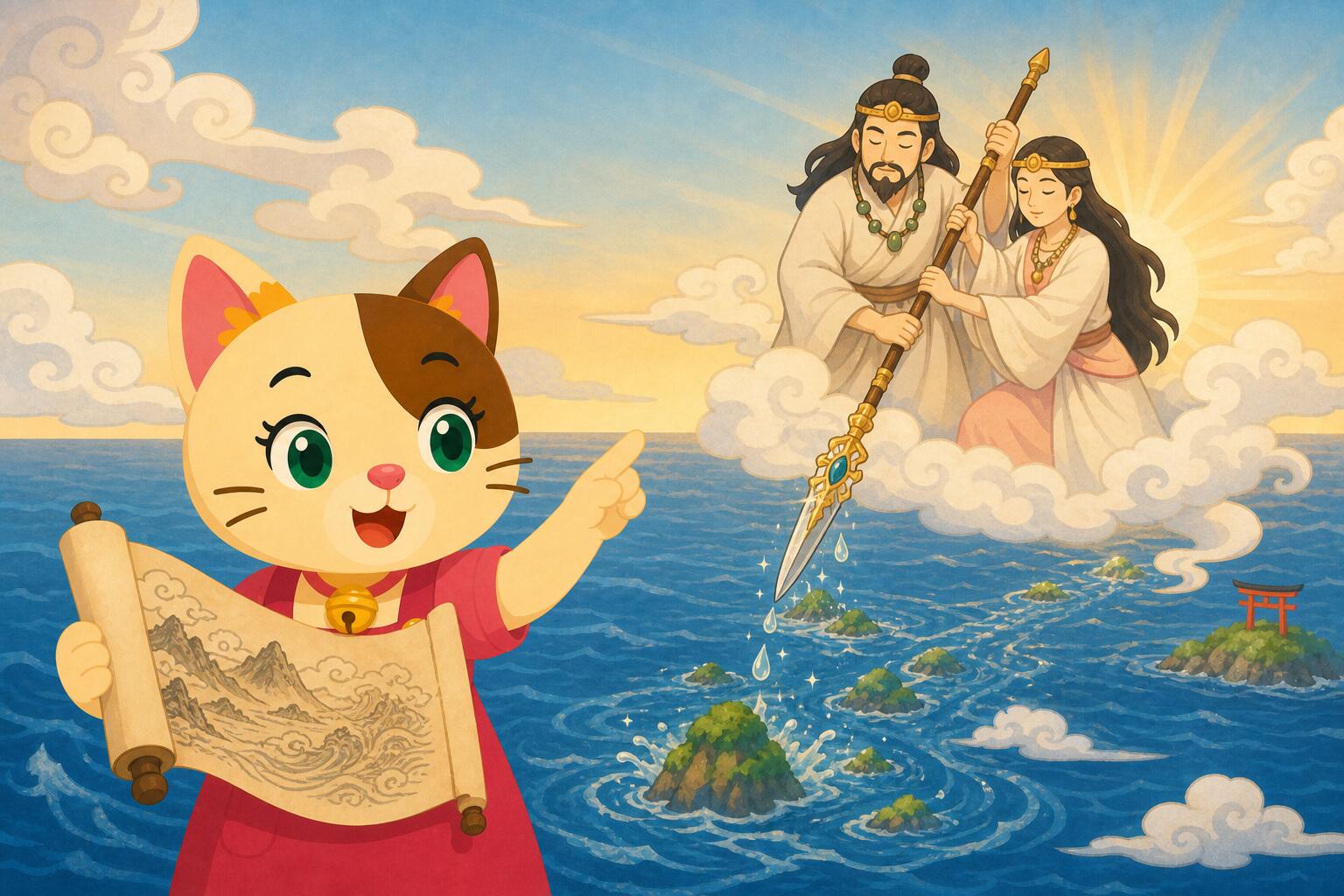
The two deities reached down from the heavens using a long spear called the Ame no Nuhoko – the "jewel-spear of heaven" – to stir the ocean. As they lifted the spear back out, droplets fell from its tip and solidified to form the first island: Onogoro. Shortly after, Izanagi and Izanami descended to the island as a romantic couple, and began creating the remaining islands of Japan.
The birth of the eight great islands of Japan
According to the myth, Izanagi and Izanami created several main islands known as the Ōyashima (大八島, "the eight great islands").
These were:
- Awaji (淡路島)
- Shikoku (四国)
- Oki (隠岐)
- Kyushu (九州)
- Iki (壱岐)
- Tsushima (対馬)
- Sado (佐渡)
- Honshu (本州)
These islands form the mythological foundation for the origin of Japan.
The birth of the nature deities
This creative burst was not just limited to the islands, however. The story goes that numerous deities linked to nature later burst forth, including:
- Mountains
- Rivers
- Wind
- The sea
Within the Shinto tradition, every major element of the natural world had its own kami (神, "god" or "divine spirit").
The death of Izanami and the birth of the underworld
So far so good for this great new land. That is until tragedy strikes: Izanami gives birth to Kagutsuchi, the god of fire.
Izanami suffers severe burns while giving birth and dies, leaving Izanagi completely devastated by the loss of his wife.
Yomi no Kuni, the land of the dead
Desperate to bring Izanami back, Izanagi travels to Yomi no Kuni, the "land of the dead." Once there, Izanami makes him promise he will not look at her. But Izanagi cannot resist, only to find that Izanami's body has already begun decomposing. Terrified, he flees, blocking the entrance to Yomi no Kuni with a huge boulder, separating the two deities forever.
The birth of Amaterasu, the sun goddess
After returning from the underworld, Izanagi performs a purification ritual. It is during this cleansing process that three of the most important gods in Japanese mythology are born:
- Amaterasu, "she who shines in the heavens": born from his left eye, she became the goddess of the sun.
- Tsukuyomi, god of the moon: born from his right eye.
- Susanoo, "the impetuous male", associated with the sea and storms: born from his nose.
Of these three deities, Amaterasu is perhaps the most significant. According to the myth, she rules the heavens, and is descended from Japan's original legendary rulers.
What does this have to do with understanding Japan?
The myth behind Japan's creation is not a historical account in the modern sense; rather, it is a religious and cultural narrative explaining how ancient Japanese people understood the origins of the world, nature, and imperial authority.
Studying stories like those of Izanagi, Izanami, and Amaterasu will help you understand cultural references that frequently appear in Japanese language, art, literature, and contemporary media.
At Khanji School, these stories are also a way to learn Japanese by connecting language and culture.
Summary of the Japanese creation myth
| Name | Definition | Role in the myth |
|---|---|---|
| Izanagi | Creator god | Creates the islands of Japan alongside Izanami and gives rise to Amaterasu, Tsukuyomi, and Susanoo during the purification ritual. |
| Izanami | Creator goddess | Helps create the Japanese islands and dies while giving birth to Kagutsuchi. |
| Ame no Nuhoko | Celestial spear | The instrument Izanagi and Izanami use to stir the ocean and give rise to the first island. |
| Onogoro | First island | The place Izanagi and Izanami descend to before creating the remaining islands of Japan. |
| Ōyashima | The eight great islands | The group of islands that forms the mythological basis for Japan's origin story. |
| Kagutsuchi | Fire god | His birth causes Izanami's death, introducing tragedy into the myth. |
| Yomi no Kuni | Land of the dead | The underworld Izanagi travels to in an attempt to retrieve Izanami. |
| Amaterasu | Sun goddess | One of the most important deities in Shinto and a figure tied to the mythical origins of the Japanese imperial family. |
| Tsukuyomi | Moon god | Born from Izanagi's right eye during the purification ritual. |
| Susanoo | God of the sea and storms | Born from Izanagi's nose during the purification ritual. |
| Kojiki | Ancient Japanese text | One of the primary sources for the myth surrounding the birth of Japan. |
| Nihon Shoki | Ancient Japanese chronicle | Another foundational source for understanding Japan's origin story. |
Frequently asked questions about Japan’s creation story
Which books tell Japan’s origin story?
The myth appears primarily in the Kojiki (古事記) and the Nihon Shoki (日本書紀), two of Japan's oldest historical and mythological texts.
Were Izanagi and Izanami gods or real people?
Within Japanese tradition, they are considered kami (神) – divine beings linked to the creation of the world and the Japanese islands.
Who is Amaterasu in Japanese mythology?
Amaterasu is the sun goddess and one of the most prominent figures in Shinto. Her story is linked to the mythical origins of the Japanese imperial family.
What does Yomi no Kuni mean?
Yomi no Kuni is the name for the underworld in Japanese mythology, a place Izanagi visits in an attempt to bring Izanami back.
Is the myth surrounding the birth of Japan history or legend?
It is a myth, not a literal historical account. Although it may appear in important ancient Japanese texts, it should be understood as a mythological explanation of Japan's origins, not fact.
|
Free download
If you've made it this far, you're serious. Turn that momentum into real progress with Chinesimple and make every study session count.
Native audio
Games
Flashcards
Exams
Pronunciation


|
|