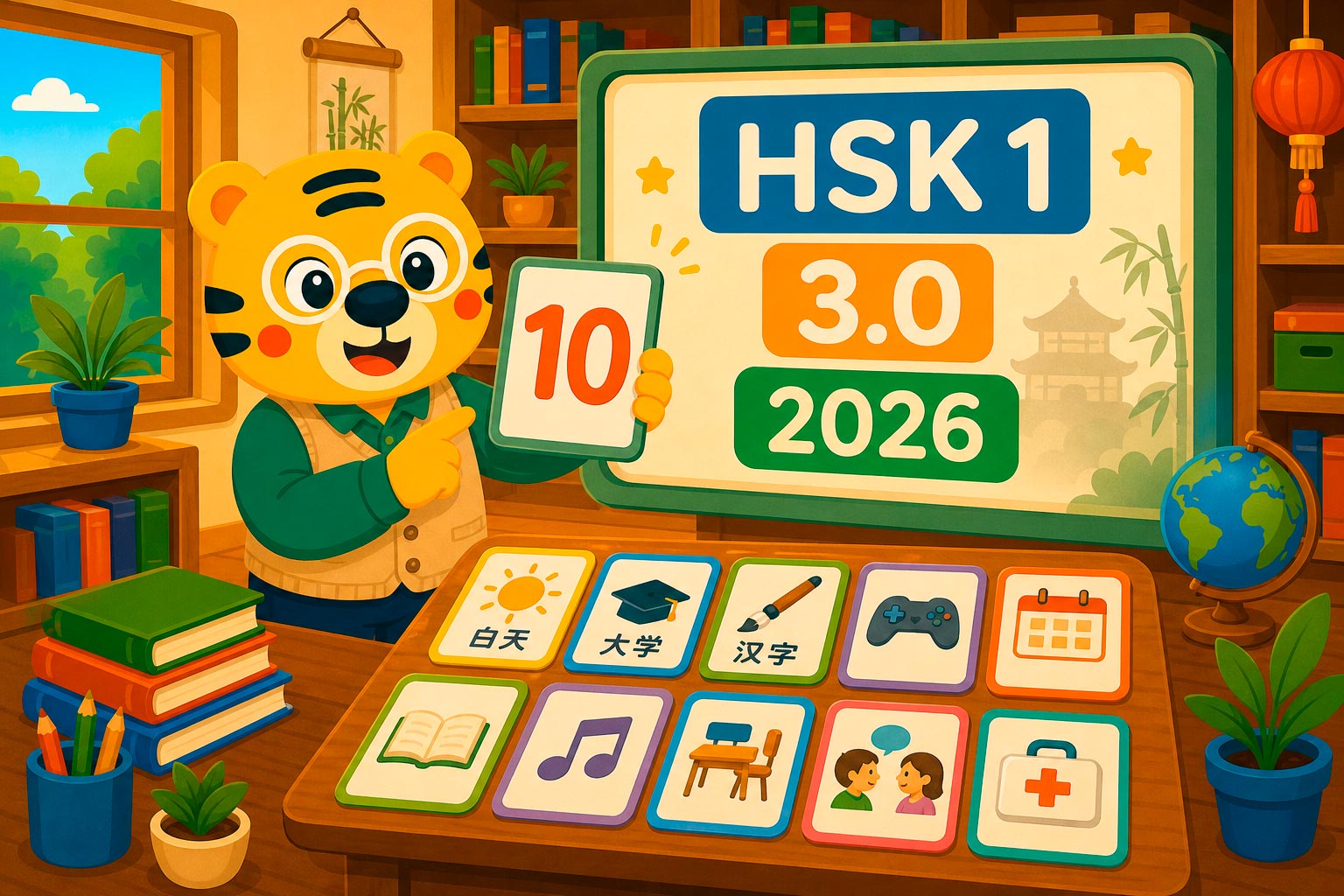
In this article, we’ll look at 10 new HSK1 3.0 words for 2026, with meanings, pinyin and example sentences in Chinese. The new HSK1 3.0 includes more than 80 terms that were not part of the old HSK lists, so we’ve selected some of the most useful ones to start with.
10 new HSK1 3.0 vocabulary words for 2026
白天 [báitiān]
白天 means “during the day” or “in the daytime”. It refers to that part of the day when it’s still light, before it gets dark.
The word is made up of 白 [bái], meaning “white”, and 天 [tiān], “day” or “sky”. Think “the bright part of the day”.
Example:
白天我上课,晚上我看电视。
[báitiān wǒ shàngkè, wǎnshang wǒ kàn diànshì]
I go to class during the day, and I watch TV at night.
大学 [dàxué]
大学 means “university”. It is made up of 大 [dà], meaning “big”, and 学 [xué], “study” or “learn”. Literally, “great study”.
Example:
她在北京大学学习。
[tā zài běijīng dàxué xuéxí]
She studies at Peking University.
In the new HSK1 3.0 list, you’ll also find 大学生 [dàxuéshēng]: “university student”.
汉字 [hànzì]
汉字 means “Chinese character” – an essential word for any student! Sooner or later you’ll be talking about reading, writing or learning characters.
汉 [hàn] refers to Chinese or the Han people, and 字 [zì] means “character” or “letter”.
Example:
我会写汉字。
[wǒ huì xiě hànzì]
I can write Chinese characters.
好玩儿 [hǎowánr], 好看 [hǎokàn] and 好听 [hǎotīng]
These three words are vital for expressing opinions in Chinese.
- 好玩儿 [hǎowánr]: fun, entertaining
- 好看 [hǎokàn]: nice, interesting to see or read
- 好听 [hǎotīng]: pleasant to listen to, something that sounds good
They all follow a very clear structure: 好 [hǎo], “good” + verb.
Examples:
这个游戏很好玩儿。
[zhè ge yóuxì hěn hǎowánr]
This game is a lot of fun.
这本书很好看。
[zhè běn shū hěn hǎokàn]
This book is really interesting.
这首歌很好听。
[zhè shǒu gē hěn hǎotīng]
This song sounds very good.
没事 [méishì]
没事 is a really versatile expression that you’ll often hear in day-to-day Chinese. Depending on the context, it can mean “it’s nothing”, “it doesn’t matter”, “it’s fine” or “I have nothing to do”.
It is made up of 没 [méi], “to not have / not exist” + 事 [shì], “matter” or “thing”.
Examples:
没事,谢谢。
[méishì, xièxie]
It’s fine, thank you.
今天我没事。
[jīntiān wǒ méishì]
I’m free today / I have nothing to do today.
有的 [yǒude]
有的 means “some”. It is used to talk about part of a group, usually in contrast with other parts.
It can really come in handy for comparisons like this: “Some are doing this, and some are doing that”.
Example:
有的学生喜欢喝茶,有的学生喜欢喝咖啡。
[yǒude xuésheng xǐhuan hē chá, yǒude xuésheng xǐhuan hē kāfēi]
Some students like to drink tea, and others like to drink coffee.
今年 [jīnnián] and 明年 [míngnián]
These two go hand in hand: 今年 means “this year” and 明年 means “next year”.
Examples:
今年我在语言学校学习汉语。
[jīnnián wǒ zài yǔyán xuéxiào xuéxí hànyǔ]
This year I am studying Chinese at the Language School.
明年我去中国。
[míngnián wǒ qù zhōngguó]
I’m going to China next year.
If you’re already familiar with 今天 [jīntiān], meaning “today”, and 明天 [míngtiān], “tomorrow”, you’ll have no problem remembering these two new terms.
上课 [shàngkè] and 上学 [shàngxué]
上课 means “to have class” or “to go to class”. 上学 means “to go to school”.
Although they may look similar, they are not used in exactly the same way.
- The phrase 上课 focuses on the class itself.
- Whereas 上学 focuses on going to school in general.
Examples:
我八点上课。
[wǒ bā diǎn shàngkè]
I have class at eight.
孩子上学了。
[háizi shàngxué le]
The child is already going to school.
男朋友 [nán péngyou] and 女朋友 [nǚ péngyou]
男朋友 means “boyfriend” and 女朋友 means “girlfriend”. As you can see, they are easily formed: 男 (man) / 女 (woman) + 朋友 (friend).
Examples:
他是我男朋友。
[tā shì wǒ nán péngyou]
He is my boyfriend.
你女朋友是英国人吗?
[nǐ nǚ péngyou shì yīngguó rén ma?]
Is your girlfriend British?
看病 [kànbìng]
看病 means “to go to the doctor” when speaking from the patient’s point of view. It literally combines 看 [kàn], “see” or “look”, with 病 [bìng], “disease” to mean “to see the disease”. But in everyday use, it is understood as meaning “to see the doctor”.
Example:
我明天去医院看病。
[wǒ míngtiān qù yīyuàn kànbìng]
I’m going to the hospital tomorrow to see the doctor.
It can also be used from the doctor’s point of view, meaning “to attend to patients” or “to examine a sick person”.
Example:
医生在看病。
[yīshēng zài kànbìng]
The doctor is seeing patients.
|
Free download
If you've made it this far, you're serious. Turn that momentum into real progress with Chinesimple and make every study session count.
Native audio
Games
Flashcards
Exams
Pronunciation


|
|