If you’re still preparing for the HSK1 as usual… you might want to take a beat. Because the HSK has changed… a lot. In 2026, HSK 3.0 officially lands, and the number of words, the grammar, and even the way you start learning to speak Chinese are no longer the same.
The new HSK 3.0 is here, complete with its updated 2026 vocabulary, and in this article you’ll learn exactly what’s changed in HSK1 and how to prepare for it.
New vocabulary for HSK 1 3.0 (2026)
The first thing you need to know is that the number of words you ultimately need to learn for HSK1 3.0 is a grand total of 300*. This is a far cry from the 150 words you were supposed to know for HSK version 2.0, but also not quite the 500 they initially announced in 2021. Let’s take a look at the most significant changes in the new vocabulary:
- To begin with, you’ll learn new separable verbs like 看病 [kànbìng] → to go to the doctor, and 生病 [shēngbìng] → to fall ill.
- The following words have been removed from HSK1:
北京 [běijīng]: Beijing
小姐 [xiǎojiě]: miss
后面 [hòumiàn]: behind
前面 [qiánmiàn]: in front of
- In general, you’ll find many new useful, everyday words, for example:
超市 [chāoshì]: supermarket
车 [chē]: car
到 [dào]: arrive
要 [yào]: want
手机 [shǒujī]: mobile phone
火车 [huǒchē]: train
觉得 [juéde]: think
可以 [kěyǐ]: can
找 [zhǎo]: search
没事 [méishì]: never mind
First off, we love this! These new words give you the basic vocabulary you actually need to get by in China right from HSK1— something that, until now, was not really introduced until the more advanced levels.
Here you can download a PDF with the new HSK1 (2026) vocabulary list in English, including example sentences (and many more in our Chinesimple app!) [insert link]
*In our PDF you’ll find 301 words… this is because we thought it would be useful for 没 to have has its own dictionary entry, separate from 没有.
Changes in grammar
- New interrogative and demonstrative pronouns have been introduced, such as:
哪里 [nǎlǐ]: where; and 哪些 [nǎxiē]: which ones
那里 [nàlǐ]: there; y 那些 [nàxiē]: those
有的 [yǒude]: certain
有些 [yǒuxiē]: some
- Some adverbs that previously didn’t appear until HSK2 have now been introduced at level 1, such as:
真 [zhēn]: really
有一点儿 [yǒu yī diǎner]: a bit
再 [zài]: again
- One notable change is that even at this beginner level, you can now create more complex sentences using adverbs such as 也 [yě] → also and 还 [hái] → in addition, still.
- Finally, you’ll learn how to use the modal particle 吧 [bā], which is widely used in Chinese and will make you sound much more fluent.
认读字 [rèndúzì] and 书写字 [shūxiězì]: characters you must recognize and characters you must be able to write
Before we dive into what the new exam looks like, let’s explore another major change in the new HSK 3.0 2026—it now specifies which characters you must be able to recognize versus which ones you must be able to write at each level.
In HSK1, you’ll need to know how to write around 90 characters, but don’t worry—they all have relatively few strokes and are quite simple. You also won’t need to know how to write them for the exam, which brings me nicely on to my next point…
What is the new HSK1 v3.0 exam like?
Fortunately, there are no major changes to the exam structure compared with version 2.0: there are 40 questions, 40 minutes, four sections in the listening section, and four in the reading section.
That said, if we take a look at the questions, we can spot a few differences:
Changes in the 听力
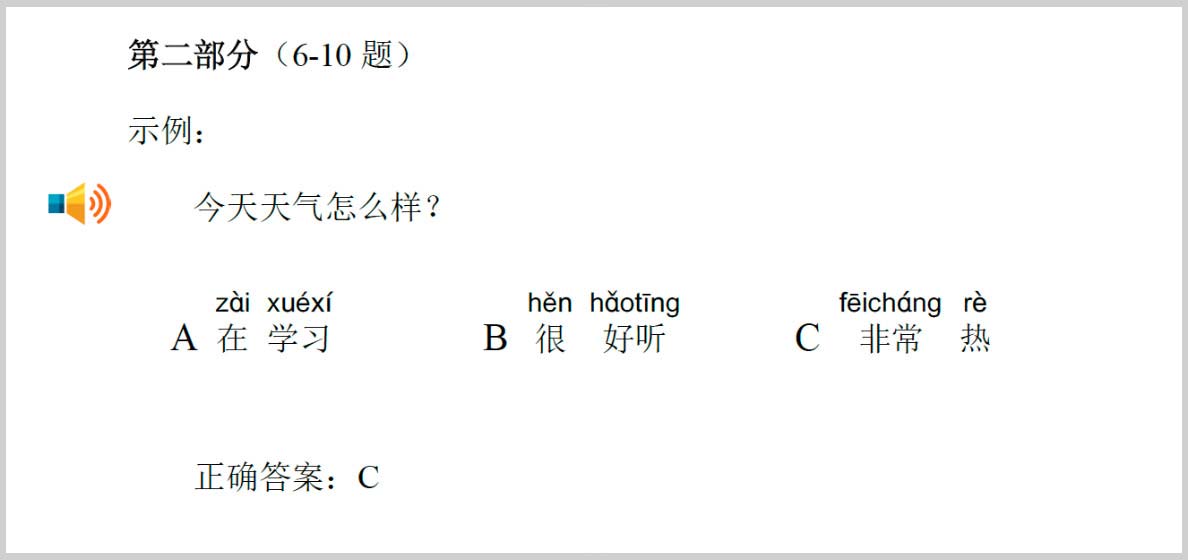
In both listening sections, we start by listening to five short sentences and matching them to an image. However, in the new HSK, the following section involves listening to five simple questions and selecting the corresponding answer for each.
New question in the 听力:
|
The other two parts remain the same: matching images with short dialogs; listening to dialogs, and answering a multiple-choice question with three options.
Changes in the 阅读
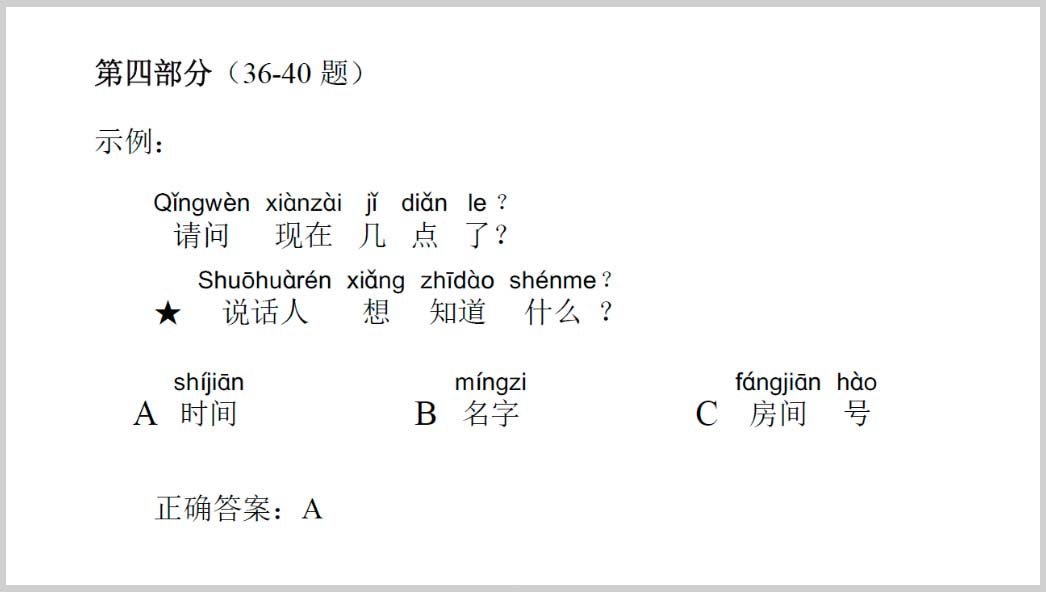
In the new HSK 3.0, the true/false section with images is no more. It has instead been replaced with a comprehension question—you’re given a sentence, asked a question about it, and have to select the correct answer from three options.
New question in the 阅读:
|
The other sections remain the same: matching images with sentences, matching questions with answers, and filling in the blanks.
Overview
As you can see, the biggest difference between the new HSK1 and the old one isn’t so much in the structure but rather in the grammar and the number of words you need to learn per level.
At Chinesimple, we see these as very positive and necessary changes. The new HSK 3.0 allows for better expression and comprehension of the language from the very beginning, helping you communicate in Chinese much sooner.
A quick reminder that the new HSK 3.0 is scheduled to be implemented from the second half of 2026.
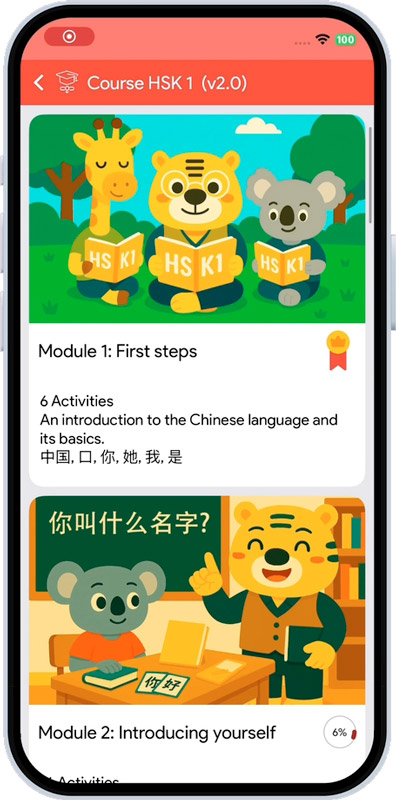
In our Chinesimple app, we’re already updating the vocabulary and creating a personalized HSK1 3.0 course. This will be your step-by-step guide to help prepare for your new official exam.
|
Free download
If you've made it this far, you're serious. Turn that momentum into real progress with Chinesimple and make every study session count.
Native audio
Games
Flashcards
Exams
Pronunciation


|
|