Ten Chinese characters with surprising etymology
In a previous video, we learned about the different types of Chinese characters based on their formation: pictograms, ideograms, compound characters, and phonosemantic characters.
In today’s article, we’re going to look at ten characters with truly captivating etymologies. Delving into the etymology of Chinese characters is not only very interesting, but it is also an excellent way to memorize them.
法 [fǎ]: law
Most Chinese learners, including beginners, will have encountered this character in words like 法国 [fǎguó] -> France, 法语 [fǎyǔ] -> French, or 语法 [yǔfǎ] -> grammar, and therefore will already know that the character 法 means “law.” But, have you ever wondered why it has the water radical?
法 is the simplified form of the traditional character 灋. In it we find the water radical again alongside the 廌 [zhì] radical (a unicorn), and at the bottom 去 [qù], which means “to go.” It is said that in ancient times, a mythological creature resembling a unicorn was able to distinguish between good and evil, and people would turn to it to act as a judge in disputes. The water radical is associated with equilibrium, balance and fairness, while 去 indicates how the animal would point out the person who had committed an injustice by charging at them or chasing after them.
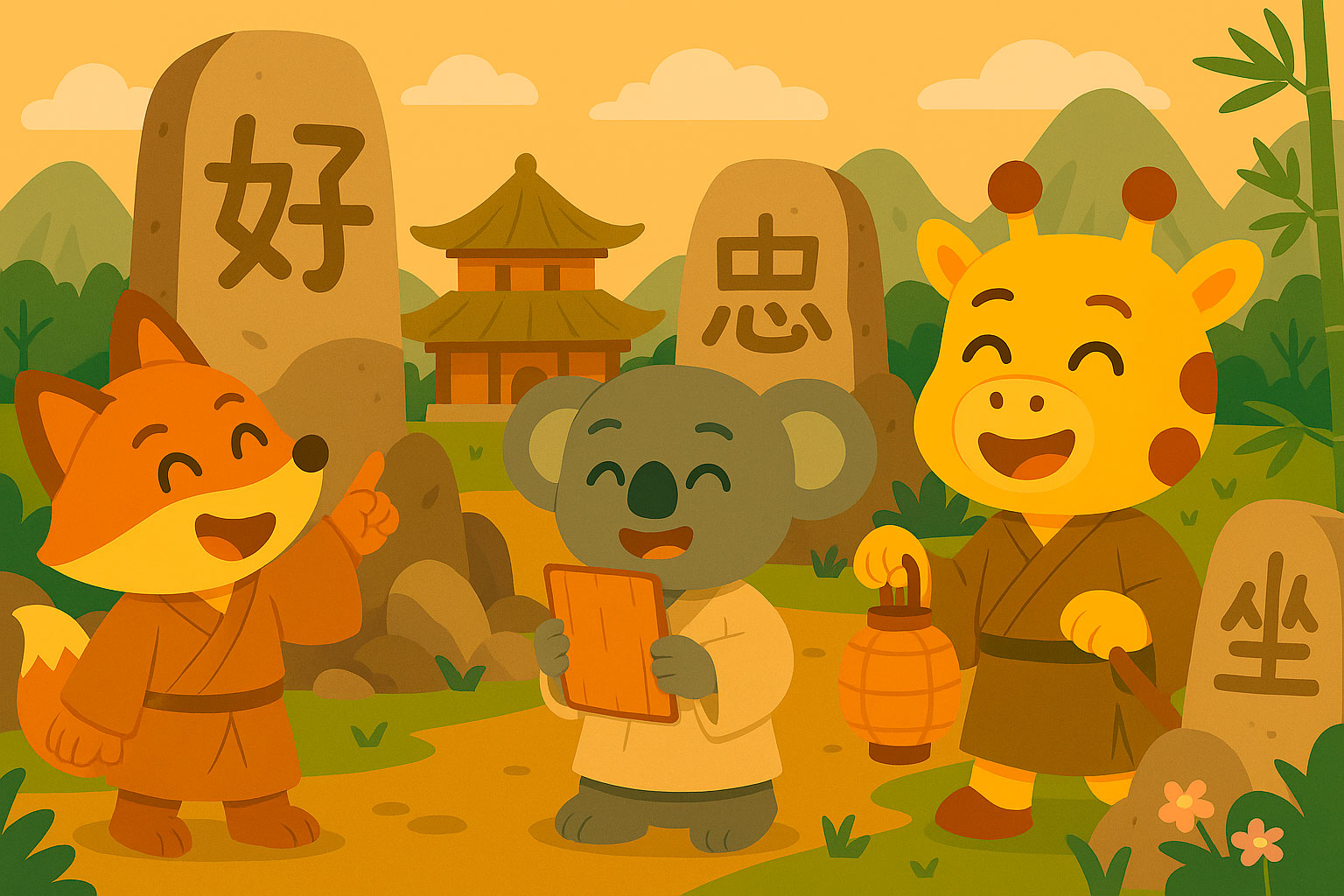
好 [hǎo]: good
Formed by the character 女 [nǚ], which means woman, and 子 [zi], which means child. Having children was considered something positive, something good.
惑 [huò]: confused; puzzled
Composed of “心” [xīn] -> heart, mind + “或” [huò] -> maybe. The combination suggests an uncertain mental state, where the mind (心) is filled with “maybes,” giving the idea of being confused or perplexed.
忍 [rěn]: to bear, to tolerate
It is composed of 刃 [rèn] -> blade, edge, over 心 -> heart. The image is symbolic: “a blade over the heart,” which suggests enduring something painful. It conveys the idea of enduring emotional or physical suffering.
忠 [zhōng]: loyalty, fidelity
It also contains the radical 心, which in many ancient forms was used to represent a moral feeling or a sense of commitment. Together with 中 [zhōng], which means “center,” 忠 is associated with the idea of having a heart “centered” on what is right, that meaning loyal or faithful.
历 [lì]: experience
Formed by the character 力 [lì] -> force, which represents the shape of agricultural plowing machinery (an action which requires all of your strength). Likewise, the other component 厂 [chāng] means “stable” or “factory.” Its traditional character 曆 [lì] also includes the components 止 (steps) and 禾 (harvest), inviting reflection on the steps taken during the completed harvest, which leads to the meaning of “experience”.
坐 [zuò]: to sit
Two people (人) on the ground (土) form the meaning of “to sit.”
香 [xiāng]: fragrant
When we want to say that something smells good in Chinese, we say “很香”. This character is composed of 禾 [hé], which means “crop” or “rice plant,” and 日 [rì], which means “sun.” In autumn, when the rice is harvested and the sun warms the fields, they emit a very pleasant fragrance.
狮 [shī]: lion
Formed from the animal radical 犭, and 师, which means teacher or leader. Together, it means “the king of the animals”, which of course, is the lion.
婚 [hūn]: to get married
In ancient times, wedding ceremonies were held at dusk or nightfall (昏), theoretically symbolizing the union of yin (night, feminine) with yang (day, masculine). Hence, this character combines 昏 (to darken, dark) with 女 (woman, bride).
There is not just one technique for memorizing characters but each student must find the method that works best for them. Learning the stories behind each one is an excellent method and as we have seen in this analysis, by studying the etymology of the characters, we can also gain a better understanding of Chinese culture and their way of thinking.
Bibliography
Kong K. y Park K, (2015), Enjoy learning Chinese characters, KONG & PARK.
https://papers.iafor.org/wp-content/uploads/conference-proceedings/ACLL/ACLL2012_proceedings.pdf
https://ctext.org/dictionary.pl?if=en
https://dict.variants.moe.edu.tw
https://www.dong-chinese.com/wiki
|
Free download
If you've made it this far, you're serious. Turn that momentum into real progress with Chinesimple and make every study session count.
Native audio
Games
Flashcards
Exams
Pronunciation


|
|