

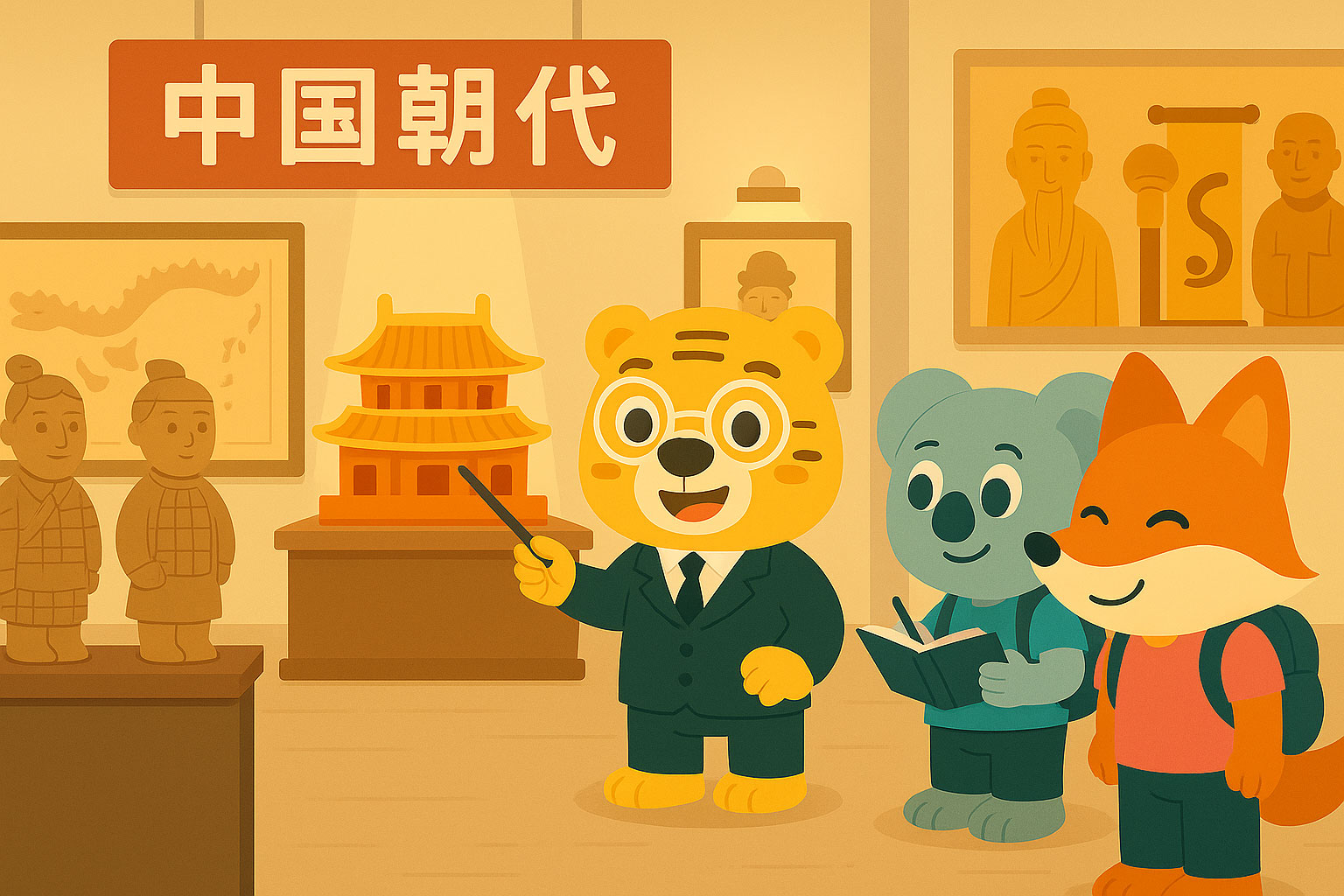
Chinese history is often framed as a series of "chapters", called dynasties. Some ruled for centuries, others for just a few decades, but all left their mark in different ways. Today, we're taking you on a journey through the most important dynasties.
夏 Xia (c. 2070-1600 BC)
Traditionally considered China's first dynasty, although its existence remains debated. It is associated with Yu the Great, who, according to legend, tamed the Yellow River floods.
商 Shang (1600-1046 BC)
The earliest widely recognized evidence of Chinese writing dates from this period, preserved on oracle bones. Advanced bronze-casting techniques also developed. Divination was practiced, and society had a clearly defined hierarchy.
周 Zhou (1046-256 BC)
The longest-lasting dynasty. It introduced the "Mandate of Heaven", the idea that a ruler governed with divine approval. This period saw the emergence of Confucius and the tradition associated with Laozi, linked to two of China's most influential philosophies: Confucianism and Taoism.
秦 Qin (221-206 BC)
Qin Shi Huang became the first emperor of a unified China. He promoted the standardization of writing, connected and extended earlier defensive walls, and left us the Terracotta Army.
汉 Han (206 BC-AD 220)
Four centuries in which the empire expanded and trade flourished along the Silk Road. New forms of writing developed, alongside major scientific and technological advances.
隋 Sui (AD 581-618)
After nearly four centuries of political fragmentation following the fall of the Han, the Sui dynasty reunified China. It built and expanded the Grand Canal and laid the administrative foundations for the flourishing Tang era. Its short rule ended partly because of the cost of large construction projects and military campaigns.
唐 Tang (AD 618-907)
A golden age of poetry, art and trade. Some historians consider it the zenith of Chinese civilization. Chang'an (now Xi'an) was one of the most cosmopolitan cities in the world.
宋 Song (AD 960-1279)
Technologies such as gunpowder, the compass and printing developed and became more widespread during this period, which also saw the invention of movable-type printing. It was an era of major technological advances, although the dynasty faced intense military pressure.
元 Yuan (AD 1271-1368)
Founded by Kublai Khan, grandson of Genghis Khan, the Yuan was the first dynasty of foreign origin to rule all of China. Contacts with Europe and Central Asia increased under its rule, and Marco Polo visited China during this period. Rebellions, economic problems and natural disasters contributed to its fall.
明 Ming (AD 1368-1644)
The Forbidden City was built during this era, and Zheng He led maritime expeditions with enormous ships. The dynasty enjoyed long periods of social and political stability.
清 Qing (AD 1644-1912)
The last imperial dynasty, also known as the Great Qing. Ruled by the Manchus, it controlled one of the largest territories in China's dynastic history. It ended in 1912, following the revolution of 1911 and the establishment of the republic.
After this journey through over 4,000 years of history, you might be wondering: is China the oldest civilization in the world? There is no single answer, because it depends on how we define a civilization and its continuity. China is one of the world's oldest civilizations and stands out for the continuity of its cultural tradition over millennia. That legacy is still very much alive today.
|
Free download
If you've made it this far, you're serious. Turn that momentum into real progress with Chinesimple and make every study session count.
Native audio
Games
Flashcards
Exams
Pronunciation


|

|


