

/ Japanese
Is green sometimes "blue" in Japan?
In a word, yes. In Japan, we sometimes use 青【あお, ao】, which usually means "blue," for things that many other languages would call green.

In a word, yes. In Japan, we sometimes use 青【あお, ao】, which usually means "blue," for things that many other languages would call green.

If you’re starting the school year and learning Chinese, the new HSK 3.0 features several words and expressions to help you talk about your studies.

Cleaning is not treated as a punishment, but as an everyday activity. And when you do something every day from an early age, it eventually becomes a habit and feels like a totally normal part of life.

The HSK2 3.0 2026 includes many terms and expressions that are particularly useful for traveling in China, from transportation, hotels, and restaurants to shopping, and directions.
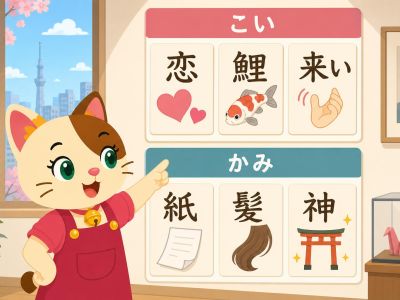
When you first start learning Japanese, one of the biggest surprises is that some words can sound exactly the same yet have completely different meanings. Kanji help make these differences immediately clear.

A new global HSK 3.0 pilot test for levels 1 to 6 will take place on 20 September 2026. However, regular HSK exams in 2026 will still follow the HSK 2.0 format.

In Japanese, yes-or-no questions usually follow the same basic word order as affirmative sentences. In polite speech, you simply add the particle か 【ka】 to the end of the sentence.

🥵 Feeling the heat this summer? 💦 Cool off with these essential Chinese words to survive the summer!

The myth surrounding the birth of Japan is mainly found in two ancient texts: the Kojiki (古事記, "Record of Ancient Matters") and the Nihon Shoki (日本書紀, "Chronicles of Japan").

The new HSK 3.0 2026 includes very modern terms related to the internet, technology, online shopping and digital life.

The short answer is yes – basic Japanese verb conjugation is much simpler than it looks at first glance.

The new HSK 3.0 has restructured the vocabulary you need for exams, meaning some words from the old HSK 2.0 are no longer on the official lists. But watch out: just because a word won’t come up in the exam doesn't mean you shouldn't learn it.