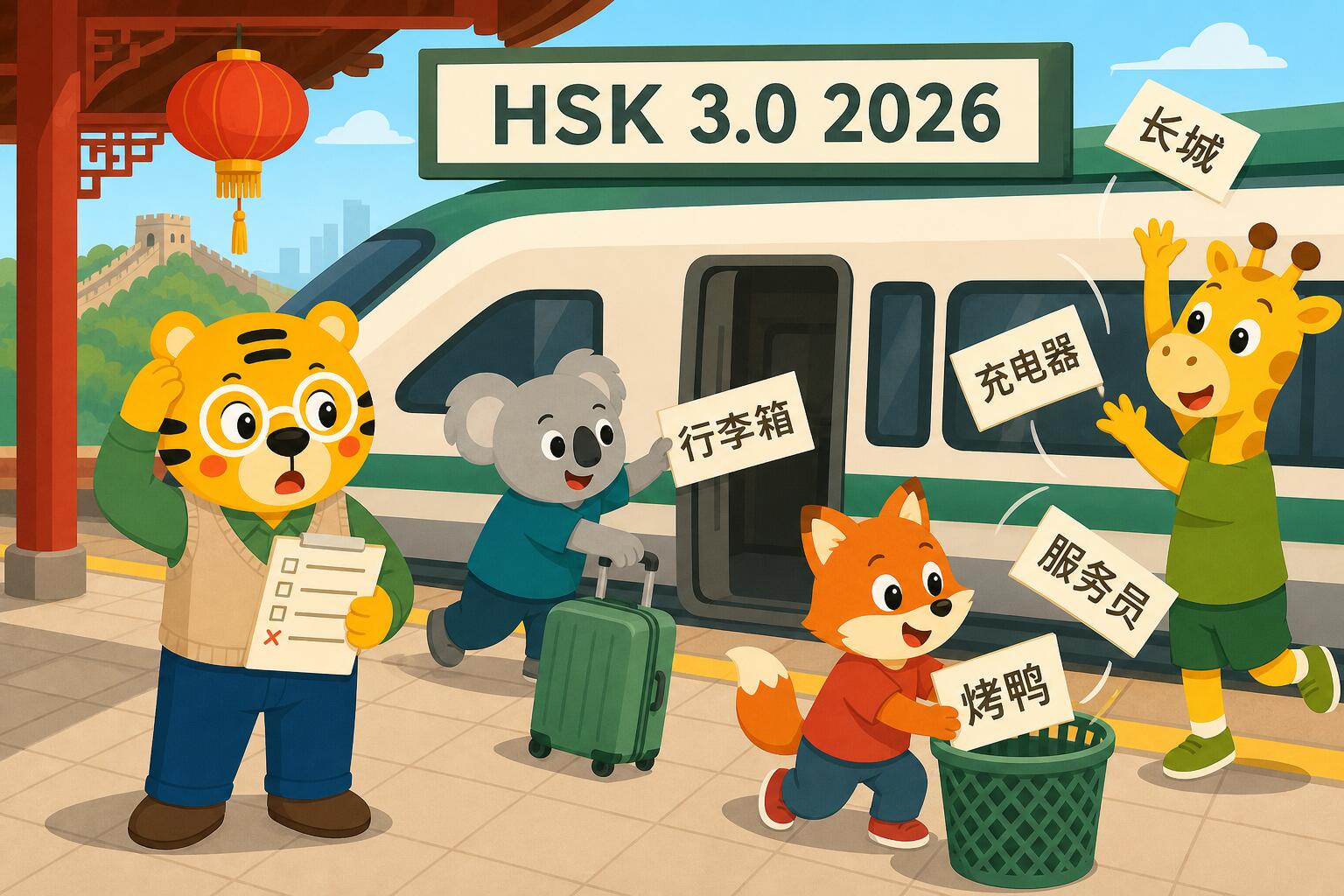
The new HSK 3.0 has restructured the vocabulary you need for exams, meaning some words from the old HSK 2.0 are no longer on the official lists. But watch out: just because a word won’t come up in the exam doesn't mean you shouldn't learn it. Many of these terms are still important for traveling in China, ordering food, getting around a city, or having everyday conversations in Chinese.
With Chinesimple by Khanji School, you can learn Chinese by combining HSK preparation with practical, real-life vocabulary. That’s why we recommend you don’t just study the official exam lists, but actually learn words that can help you in travel, conversations, and everyday situations.
Below, we’ve highlighted some words that are leaving the HSK list, but which are still highly recommended for any Chinese learner.
Some useful words for traveling in China are no longer in the new HSK
This is probably the topic which has lost the most vocabulary. However, if you’re planning to travel to China, we recommend that you still learn these words:
- 行李箱 [xínglixiāng]: suitcase
- 北京 [Běijīng]: Beijing
- 长城 [Chángchéng]: Great Wall
- 熊猫 [xióngmāo]: panda bear (the word you’ll see the most in Chengdu when visiting panda bears 😉)
- 登机牌 [dēngjīpái]: boarding pass
Some everyday words are important even if they’re no longer on the HSK lists
Some very useful everyday terms have also disappeared:
- 照相机 [zhàoxiàngjī]: camera
- 充电器 [chōngdiànqì]: charger
- 粉色 [fěnsè]: pink
- 付款 [fùkuǎn]: to pay
- 电子邮件 [diànzǐ yóujiàn]: email
Food and restaurant vocabulary is useful even if it won’t always be in the exam
Food vocabulary is some of the most practical in real life, even if it doesn’t always come up in the exam. So if you want to enjoy the delicious Chinese cuisine, you should know these terms:
- 烤鸭 [kǎoyā]: roast duck
- 服务员 [fúwùyuán]: waiter
- 羊肉 [yángròu]: mutton
- 售货员 [shòuhuòyuán]: seller/vendor (for example, in a supermarket)
The HSK helps structure your studies, but it does not replace real-life vocabulary
The HSK is a very useful tool for studying Chinese in a structured way. Its vocabulary lists help you measure progress and prepare for exams with clear objectives.
However, learning Chinese is not just about memorizing words for an exam. It’s also about knowing common terms for travel, conversations, restaurants, shopping, culture, technology, and everyday situations.
With Chinesimple by Khanji School, HSK vocabulary provides a solid foundation to progress in Chinese, but is always linked to examples, context, and real-life usage. The key is to combine exam study with practical words that can help you communicate outside the classroom.
FAQs
Are these words no longer used in Chinese?
No. Just because a word is no longer in the HSK doesn’t mean it isn’t used anymore. It just no longer appears as an official term on the new exam lists.
Do I have to learn words that are not in the HSK?
Yes, as long as they are useful to you. As the saying goes, "knowledge is power". The HSK helps structure your studies, but it doesn't cover all the vocabulary you need to travel, speak with natives, or understand Chinese culture.
Why have words been removed from HSK 3.0?
Because the new system comes with different levels, priorities, and vocabulary. The official lists cannot cover every single Chinese term, so some words don’t make the cut, even though they are still common in everyday use.
|
Free download
If you've made it this far, you're serious. Turn that momentum into real progress with Chinesimple and make every study session count.
Native audio
Games
Flashcards
Exams
Pronunciation


|
|