Compared to HSK1, the new HSK2 3.0 2026 includes just 200 new words. Let’s explore why it might be the most accessible level in the new HSK.
When we think of the easiest Chinese exam, your mind would usually go straight to HSK1. After all, it is the first official level. However, with the arrival of the new HSK 3.0, HSK2 might actually be the easiest level to prepare for in the initial learning journey. But, how so?
You only need to learn 200 new words
The new HSK 3.0 program, officially announced in 2025 and scheduled for global rollout from July 2026, has split its vocabulary across the various levels as follows:
| Level | HSK 2.0 | New HSK 3.0 (2026) |
|---|---|---|
| HSK 1 | 150 | 300 |
| HSK 2 | 300 | 500 |
| HSK 3 | 600 | 1000 |
| HSK 4 | 1200 | 2000 |
| HSK 5 | 2500 | 3600 |
| HSK 6 | 5000 | 5400 |
| HSK 7-9 | - | 11000 |
The number of words per level is cumulative. This means that, as you progress through the levels, the words you’ve studied in previous levels are added together to make a combined total.
The arrival of the new HSK 3.0 now means there are 300 words at HSK1 level and just 500 at HSK2.
This doesn’t mean you need to learn another 500 words after you pass HSK1, but just 200 more. In other words, HSK 3.0 level 2 requires you to learn the smallest number of new words to take the official exam.
Everyday grammar
Another reason why HSK2 3.0 could be considered the easiest level? The grammar is particularly accessible.
While HSK2 does include some new structures that require a strong command of the syntax covered in HSK1, in general, the grammar in HSK2 is useful for everyday communication and can be taught through very clear examples:
- 为什么 [wèishénme]: why
- 每 [měi]: each
- 一起 [yìqǐ]: together
- 别 [bié]: don’t... (imperative)
- 自己 [zìjǐ]: oneself
- 已经 [yǐjīng]: already
- 可能 [kěnéng]: maybe, possibly
- 还是 [háishi]: or, still, it would be better to...
In many instances, it even expands on and provides nuance for structures you learned at the previous level.
You’ve already done the hard part
For most students, the biggest challenge is not tackling HSK2, but getting started in the first place.
In HSK1, you have so much to get to grips with:
- tones
- pinyin
- writing characters
- pronunciation
- Chinese sentence structure
The good news is, once you’ve overcome that first hurdle the language only gets easier, because your brain already understands how Chinese works. That's why HSK2 often feels more natural, because you're not starting from scratch: you're building on an existing foundation.
So... Is HSK2 the easiest level?
Possibly yes, but it is worth clarifying: HSK1 is still the most basic level and, in absolute terms, the easiest exam. The difference is that HSK2 can be easier to prepare for, not because it has less content than HSK1, but because it mostly builds on all of your previous work. You only need to learn 200 new words, the grammar switches up very gradually, and you have already got over the biggest hurdle of starting to study Chinese in the first place. Ultimately, the learning curve is much gentler.
This is the point when many students stop feeling like they are "learning an impossible language" and finally start to enjoy using it.
So, if you have just finished HSK1, now is probably the best time to keep the ball rolling. The jump to HSK2 is much smaller than it seems.
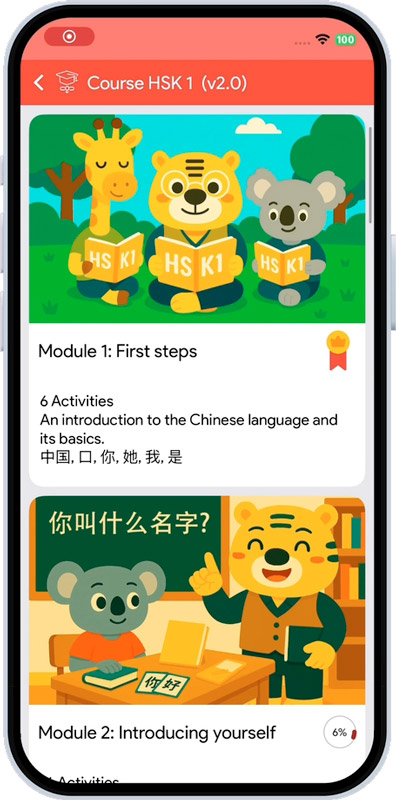
Want to check it out for yourself? Try the HSK2 3.0 course in our Chinesimple app! We’ll be with you every step of the way on your Chinese learning journey, through lessons, games, stories, and much more, making learning fun.
|
Free download
If you've made it this far, you're serious. Turn that momentum into real progress with Chinesimple and make every study session count.
Native audio
Games
Flashcards
Exams
Pronunciation


|
|