The PDF containing the new HSK2 3.0 vocabulary for 2026 is now ready to download!
In this article, we will take a closer look at the major changes:
- How much new vocabulary has been introduced?
- What are the most relevant terms?
- What new grammar do I need to learn?
How many words does HSK2 3.0 have?
To take the HSK2 3.0 exam, you now need to know a total of 500 words: 300 from HSK1 3.0 and 200 new ones for HSK2 3.0. In other words, it’s not quite as much work as HSK1, as there are fewer words to learn.
Likewise, the number of characters you need to know (认读字) is 353: 228 from HSK1 and 125 new ones from HSK2. At this level, you are not yet required to know how to write characters, and during the exam, you will have the support of pinyin.
New HSK2 3.0 words
These are some new terms that were not included in the old HSK2 2.0, nor in any other level, so they are worth highlighting:
- 不错 [bùcuò]: this is a very common expression used to indicate that something “is quite good” or “not bad at all.”
- 不好意思 [bùhǎoyìsi]: besides 对不起 [duìbúqǐ], this is another common way to apologize.
- 打车 [dǎchē]: means “to take a taxi,” whether that’s hailing it on the street or using a mobile app. Taking a taxi in China using apps like 滴滴 is so common that this term just had to be in there.
- 打开 [dǎkāi]: meaning open. This verb was also a must, along with a proper explanation of how it differs from 开. The latter has more meanings and therefore can be used in different contexts. 打开 only means “to open.”
- 有意思 / 没意思 [yǒu yìsi / méiyìsi]: “interesting” and its antonym, “boring,” couldn’t be left out. These two terms that every Chinese student knows before reaching HSK3 are now included in the official lists.
- 门口 [ménkǒu]: entry. One thing that stands out about the new 3.0 vocabulary in general is that it includes useful terms you can use when going on a trip.
- 门票 [ménpiào]: entry ticket, admission ticket.
- 奶茶 [nǎichá]: milk tea. A current and very on-trend term in China, the famous milk teas or bubble tea have reinvented Chinese tea culture.
- 姓名 [xìngmíng]: first and last name. A very useful term when filling out forms, taking exams, or, again, traveling.
- 这样 / 那样 [zhèyàng / nàyàng]: in this way, like this. These demonstrative pronouns are very useful when it comes to sounding more fluent.
New HSK2 3.0 grammar
At this level, you’ll now find grammatical points that were previously only explained at more advanced levels. Let’s check out the most relevant ones:
- 还是……吧: Use this to express your preference for doing one thing instead of another.
- 比 and 得: To help you nail comparisons.
- Verb + 来/去: The directional complements 来/去, which are commonly used in Chinese, are now included from the very beginning of HSK2.
- 地: to “adverbialize,” or convert into an adverb. This is used after an adjective or a verb to indicate the way in which the action is performed.
- 着: The basic uses of 着 are explained over several HSK2 lessons to prepare you to delve deeper into HSK3.
Differences between HSK2 2.0 and HSK2 3.0
The expansion of the official HSK2 3.0 word list is super useful, as it incorporates current terms, practical vocabulary for traveling in China, and expressions that help you communicate better even from beginner levels.
The same can be said for the grammar, a large percentage of which comes from HSK3 and therefore offers greater knowledge and understanding of the language, as well as more fluent expression.
Download HSK2 3.0 Vocabulary
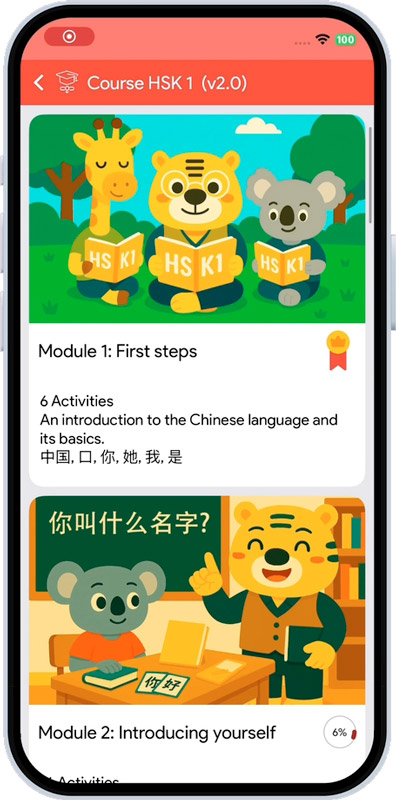
You can check out these changes in our app, which is already loaded with the new HSK 3.0 2026 vocabulary, plus grammar lessons to cover the new content.
You will also soon have access to a guided HSK2 3.0 course, guiding you through this level step by step so you can pass the official exam!
Download here the new HSK2 3.0 2026 vocabulary list in PDF format.
|
Free download
If you've made it this far, you're serious. Turn that momentum into real progress with Chinesimple and make every study session count.
Native audio
Games
Flashcards
Exams
Pronunciation


|
|