中秋节 [zhōngqiūjié] is the Mid-Autumn Festival, one of China's most important traditional celebrations. In this article, you will discover the origins of this festival and how it is celebrated. Of course, you'll also learn about the famous mooncakes that accompany the occasion.
The Mid-Autumn Festival is celebrated on the 15th day of the eighth month of the Chinese lunar calendar, when there is a full moon. In 2026, it is on 25 September, but the date varies from year to year in the Gregorian calendar because it is calculated according to the Chinese lunar calendar.
How did the Mid-Autumn Festival begin?
The origins of the Mid-Autumn Festival are linked to ancient moon-worship rituals and harvest celebrations.
The festival falls during the autumn harvest season, when people in ancient China gathered to celebrate the crops they had collected. These celebrations were often connected with moon worship, through which people gave thanks and prayed for a bountiful harvest.
The expression 中秋 was already used during the Han dynasty. Literally, 中 [zhōng] means "middle" and 秋 [qiū] means "autumn".
Later, during the Tang dynasty, moon viewing became an increasingly popular custom, and legends such as that of Chang'e became associated with the festival.
Finally, during the Northern Song dynasty (960-1127 CE), the 15th day of the eighth lunar month was officially established as the Mid-Autumn Festival.
What does the Mid-Autumn Festival celebrate?
The Mid-Autumn Festival celebrates the harvest and the full moon, but above all, it is closely connected with family.
This is because the full moon is associated with 团圆 [tuányuán], meaning "family reunion". In Chinese, 圆 [yuán] means "round", but it can also convey the idea of something complete and fulfilled. For this reason, during the Mid-Autumn Festival, the full moon and round mooncakes symbolise the hope that families will be reunited and live in harmony.
For many people, it is also a time to remember family members or friends who are far away. Looking at the full moon can remind them that people far apart are still sharing the same moon.
This idea is also reflected in the legend of 嫦娥, Chang'e, the moon goddess. There are several versions of the story, but the best-known one tells how Chang'e drank an elixir of immortality and flew to the moon. Her husband, the archer 后羿 [Hòuyì], missed her and looked at the moon to feel closer to her.
How is the Mid-Autumn Festival celebrated?
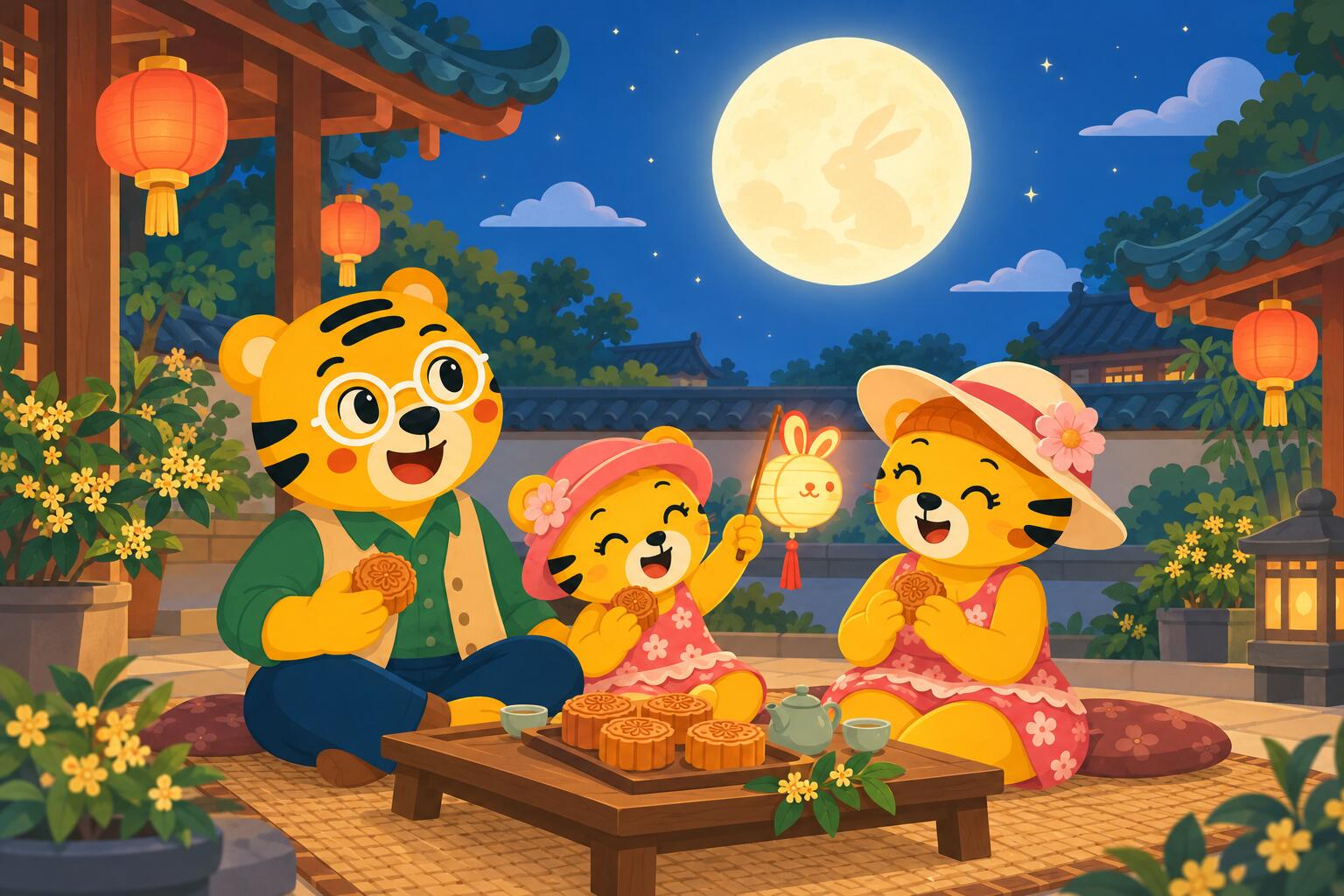
Chinese families usually get together for dinner and admire the full moon on this day. Of course, no Mid-Autumn Festival would be complete without the traditional mooncakes, known as 月饼 [yuèbǐng].
In some regions, people light lanterns and solve lantern riddles, known as 灯谜 [dēngmí].
月饼: mooncakes
月饼 [yuèbǐng] are traditional pastries associated with the Mid-Autumn Festival. They are usually round, like the full moon, and are therefore also associated with family reunion, making them a fitting food for the celebration.
It is common to give mooncakes to family members, friends and colleagues before the festival. Sharing them is a way of wishing others togetherness and happiness.
There are many regional varieties, as well as newer modern varieties. Some common fillings include:
- 五仁 [wǔrén]: a mixture of five types of nuts and seeds.
- 莲蓉蛋黄 [liánróng dànhuáng]: lotus seed paste with salted egg yolk. This is one of the best-known varieties and is typical of Cantonese-style mooncakes.
- 抹茶 [mǒchá]: matcha. Matcha-flavoured mooncakes have become more popular in recent years.
- 鲜花月饼 [xiānhuā yuèbǐng]: flower mooncakes. They are typical of Yunnan province and are often filled with edible roses.
- 豆沙 [dòushā]: sweet red bean paste. It is one of the most common sweet fillings.
Key Mid-Autumn Festival vocabulary
- 中秋节 [zhōngqiūjié]: Mid-Autumn Festival
- 月亮 [yuèliang]: moon
- 月饼 [yuèbǐng]: mooncake
- 团圆 [tuányuán]: family reunion
- 赏月 [shǎngyuè]: to admire the moon
- 灯笼 [dēnglong]: lantern
- 满月 [mǎnyuè]: full moon
- 灯谜 [dēngmí]: a riddle written on or associated with a lantern
中秋节快乐!
[zhōngqiūjié kuàilè!]
Happy Mid-Autumn Festival!
|
Free download
If you've made it this far, you're serious. Turn that momentum into real progress with Chinesimple and make every study session count.
Native audio
Games
Flashcards
Exams
Pronunciation


|
|