
Looking for your next Chinese drama? From period romances to workplace dramas, these ten C-dramas from 2026 are bound to hit the spot – and offer new ways to practise your Chinese as you watch.
逐玉 Pursuit of Jade
This historical romance stars Zhang Linghe and Tian Xiwei. It follows Fan Changyu, a butcher's daughter, and Xie Zheng, a fallen nobleman seeking revenge for a past family tragedy. Initially thrown together by a marriage of convenience, their story soon twists and turns towards war and political intrigue.
In Chinese, 逐 [zhú] means "to pursue", and 玉 [yù] means "jade".
主角 The Lead
How does a young girl go from tending goats to becoming an opera star? "The Lead" follows the life and career of Yi Qin'e over decades of social change, exploring the dedication and setbacks behind a life on stage.
The series introduces viewers to 秦腔 [qínqiāng], a regional genre of opera associated with Shaanxi and northwestern China. It's a chance to see the many different traditions Chinese opera has to offer, each with its own music and performance style.
主角 [zhǔjué] means "leading role" or "main character". Watch out for 角: in this word, it's pronounced [jué], not [jiǎo].
太平年 Swords Into Plowshares
Set during the Five Dynasties and Ten Kingdoms period, this period drama follows Qian Hongchu, the ruler of Wuyue, and the events that lead to his decision to bring Wuyue under Song rule. The story is shaped by power struggles and warfare, and the way decisions made high up trickle down to ordinary people.
太平 [tàipíng] means "peaceful" or "peace and tranquillity", especially in the sense of freedom from war or unrest.
兰香如故 Against the Current
When Shen Jialan's family is accused of treason, her life turns upside down. To survive, she disguises herself as a maid by the name of Xu Lanxiang, working for the family she was once supposed to marry into.
如故 [rúgù] means "as before" or "unchanged", 兰 [lán] means "orchid", and 香 [xiāng] means "fragrance", meaning an orchid that remains as fragrant as ever.
生命树 Born to Be Alive
Starring Yang Zi and Hu Ge, this drama takes us to the Qinghai–Tibet Plateau. The story begins in the 1990s and follows a patrol team tackling poaching and illegal mining, with a heavy environmental focus.
The Chinese title combines two easily recognisable words: 生命 [shēngmìng], "life", and 树 [shù], "tree", literally meaning "the tree of life".
成何体统 How Dare You
Imagine waking up to find yourself in a novel, only to discover that your character is headed for a tragic ending. That's the premise of this period romantic comedy, which plays on familiar palace-drama tropes. Wang Churan and Cheng Lei play characters trapped in the roles of villainous consort and tyrannical emperor.
成何体统 [chéng hé tǐtǒng] is a phrase used to express disapproval at behaviour deemed improper. Depending on the context, it can mean "How disgraceful!" or "This is outrageous!" It has a formal, theatrical ring to it.
轧戏 Love Between Lines
In Love Between Lines, two people meet through an immersive murder mystery game set in Republican-era China, only to later cross paths again in the real world.
Starring Chen Xingxu and Lu Yuxiao, the series moves between their fictional roles and their present-day lives. The story centers on 剧本杀 [jùběnshā], a mystery role-playing game in which participants take on characters and follow a script containing clues.
低智商犯罪 Born with Luck
The stars of this crime comedy, played by Wang Xiao, Tian Xiwei and Wang Chuanjun, are hardly criminal masterminds. Bad decisions, misunderstandings and unexpected twists give the story its comic edge.
The Chinese title really says it all: 低 [dī] means "low", 智商 [zhìshāng] means "IQ", and 犯罪 [fànzuì] means "crime" or "to commit a crime" – essentially "low-IQ crime".
早春晴朗 The Early Spring
Starring Jing Boran and Sun Qian, this office romance explores the attraction between a boss and their employee, and the ways their personal relationship becomes entangled with workplace tensions.
The title combines 早春 [zǎochūn], "early spring", and 晴朗 [qínglǎng], "clear" or "sunny".
冬去春来 Live Up to Your Youth
A small guesthouse in 1990s Beijing brings together young people from across China, each hoping to make it in the big city. Their ambitions and setbacks offer a glimpse of a changing era.
The drama also introduces the term 北漂 [běipiāo], used for people moving to Beijing from across the country in search of opportunities and a career.
The title is made up of the terms 冬 [dōng], "winter"; 去 [qù], "to go"; 春 [chūn], "spring"; and 来 [lái], "to come". Literally, "winter goes, spring comes".
At Khanji School, we encourage you to combine your studies with content you enjoy. Watching a series can help you recognise familiar words in new situations, and improve your listening skills.
FAQs
Which of these dramas are best for practising everyday Chinese?
The Early Spring and the present-day scenes in Love Between Lines are useful starting points because of their modern settings. That doesn't necessarily make the dialogue easier, but the vocabulary may be more relevant to everyday conversations.
Can I watch Chinese dramas as a beginner?
Absolutely. Start with English subtitles to follow the story, then rewatch a short scene with Chinese subtitles if they're available. Listen for familiar greetings, numbers and phrases.
Can Chinese dramas help me learn Mandarin?
Yes. They can complement your studies by giving you listening practice and showing you how familiar words and phrases work in context. You may also come across everyday expressions that don't always appear in textbooks.
Where can I watch these dramas with English subtitles?
Availability and subtitle options vary by title and country. Check the official listings on platforms such as iQIYI, WeTV, Netflix and Youku.
|
Free download
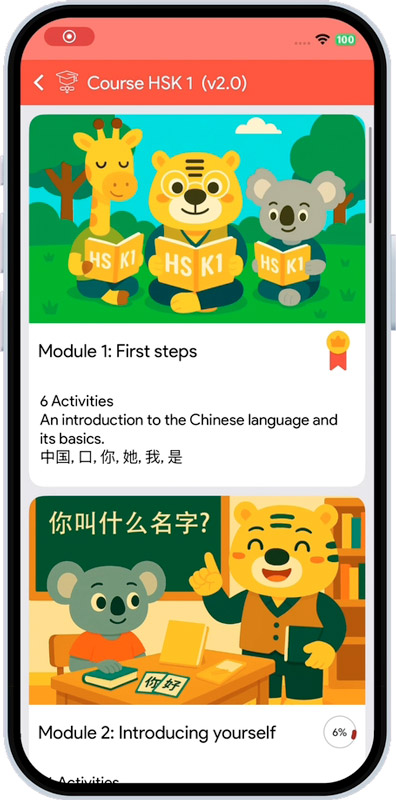
If you've made it this far, you're serious. Turn that momentum into real progress with Chinesimple and make every study session count.
Native audio
Games
Flashcards
Exams
Pronunciation


|
|