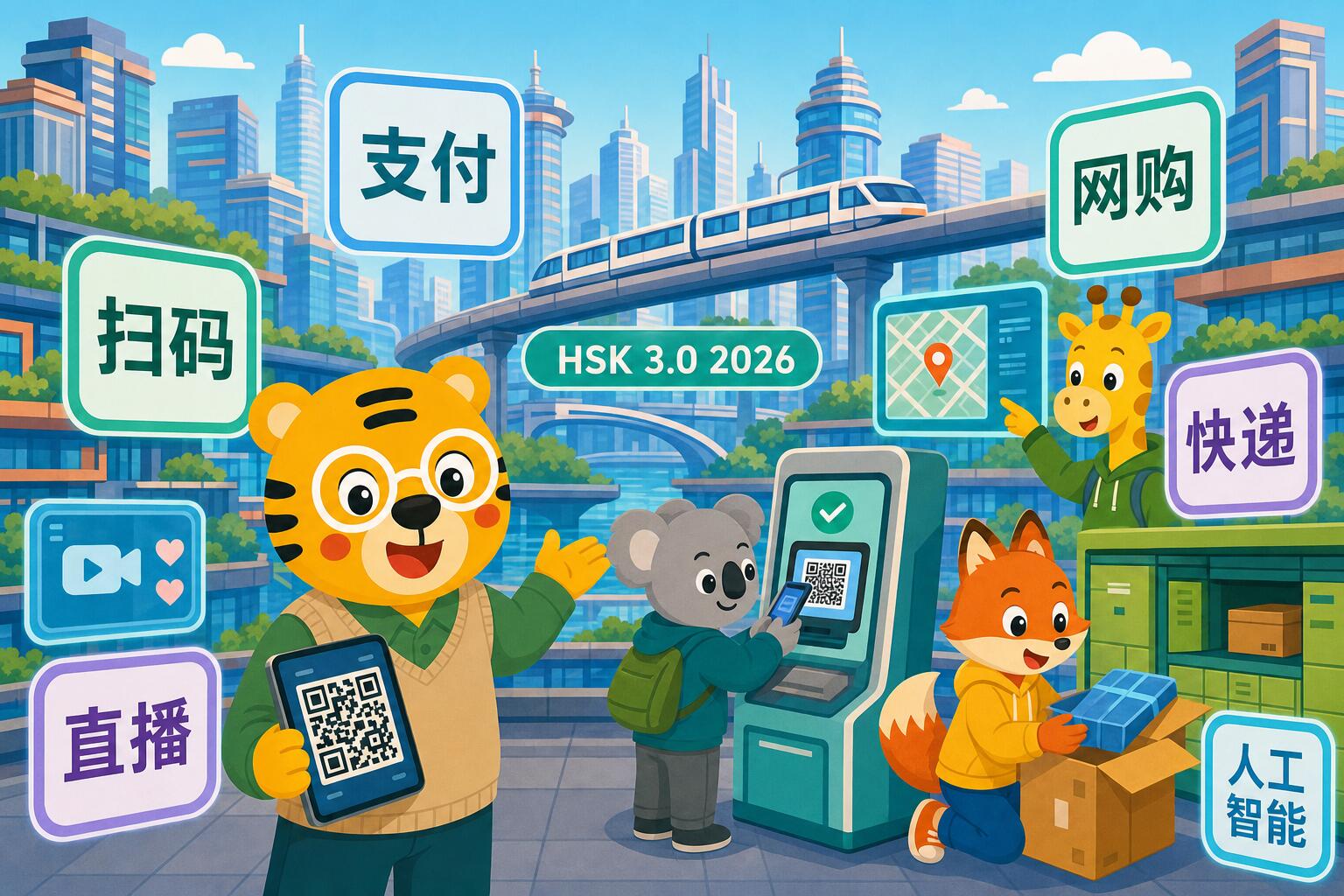
The new HSK 3.0 2026 includes very modern terms related to the internet, technology, online shopping and digital life.
The HSK 3.0 is the latest version of the official Chinese proficiency exam for non-native speakers. On top of its restructured levels and vocabulary, the new HSK includes words that better reflect modern life, such as working and shopping online, using digital platforms or talking about artificial intelligence.
In this article, we review 10 current Chinese terms related to technology, the internet and digital life in China from the new HSK 3.0 2026, plus their relevant pinyin, meanings and examples.
1. 扫码 [sǎomǎ]
扫码 means “to scan a QR code”. In China, you’re already much more likely to pay for something with your phone than with cash. Sellers can simply scan a QR code linked to your bank account. You will also usually scan a QR code to order food in a restaurant or to add friends on WeChat. For the latter, you would usually say:
Example
| hanzi | pinyin | meaning |
|---|---|---|
| 你扫我,还是我扫你? | nǐ sǎo wǒ, háishi wǒ sǎo nǐ? | Do you want to scan me, or should I scan you? |
2. 登录 [dēnglù] and 注册 [zhùcè]
To access many online services, you will often need to “log in” (登录) or “register” (注册).
Example
| hanzi | pinyin | meaning |
|---|---|---|
| 你可以用电子邮件或者手机号登录 | nǐ kěyǐ yòng diànzǐ yóujiàn huòzhě shǒujīhào dēnglù | You can log in with your email address or phone number. |
3. 导航 [dǎoháng]
An essential part of our modern-day toolkit: “GPS navigation”, or “GPS”.
Example
| hanzi | pinyin | meaning |
|---|---|---|
| 我们迷路了,打开导航看看怎么回家 | wǒmen mílù le, dǎkāi dǎoháng kànkan zěnme huí jiā | We’re lost, open the GPS and let’s see how to get home |
4. 网购 [wǎnggòu]
Over the last decade, e-commerce has transformed the way we shop. If you’re looking to stay up to date, you should know 网购, which means “to shop online”. It combines 网, “network/internet”, and 购, “to buy”.
Example
| hanzi | pinyin | meaning |
|---|---|---|
| 很多人喜欢网购 | hěn duō rén xǐhuan wǎnggòu | Many people like shopping online. |
5. 支付 [zhīfù]
支付 means “to pay” or “to make a payment”. As mentioned above, mobile payments are the norm in China. One of the most popular payment apps is called 支付宝 [zhīfùbǎo], Alipay.
Example
| hanzi | pinyin | meaning |
|---|---|---|
| 我可以用手机支付吗? | wǒ kěyǐ yòng shǒujī zhīfù ma? | Can I pay with my phone? |
6. 快递 [kuàidì]
快递 means “package”, “delivery” or “courier service”. If you shop online, you should definitely familiarise yourself with this term.
Example
| hanzi | pinyin | meaning |
|---|---|---|
| 我的快递到了 | wǒ de kuàidì dào le | My package has arrived. |
7. 直播 [zhíbō]
直播 means “live broadcast” or “livestream”. It’s a pretty modern word, especially in the social media, e-commerce and entertainment worlds.
Example
| hanzi | pinyin | meaning |
|---|---|---|
| 她每天晚上直播 | tā měitiān wǎnshang zhíbō | She livestreams every night. |
8. 账号 [zhànghào]
账号 means “account” or “username” on a digital platform. It’s a useful word for apps, social media, websites and online services.
Example
| hanzi | pinyin | meaning |
|---|---|---|
| 我忘了我的账号 | wǒ wàng le wǒ de zhànghào | I forgot my username. |
9. 人工智能 [réngōng zhìnéng]
人工智能 means “artificial intelligence” or AI. It’s one of the most modern terms in the new HSK.
Example
| hanzi | pinyin | meaning |
|---|---|---|
| 你觉得人工智能有用吗? | nǐ juéde réngōng zhìnéng yǒuyòng ma? | Do you think artificial intelligence is useful? |
10. 下载 [xiàzài]
下载 means “to download”. For example, an app, a file, or an ebook, etc.
Example
| hanzi | pinyin | meaning |
|---|---|---|
| 你还没下载那个最近很火的 app 吗? | nǐ hái méi xiàzài nà ge zuìjìn hěn huǒ de app ma? | Haven’t you downloaded that app everyone has been talking about? |
The new HSK also reflects modern Chinese
Far from falling behind the times, or limiting itself to “textbook Chinese”, the new HSK has introduced terms that reflect China’s contemporary and technological reality.
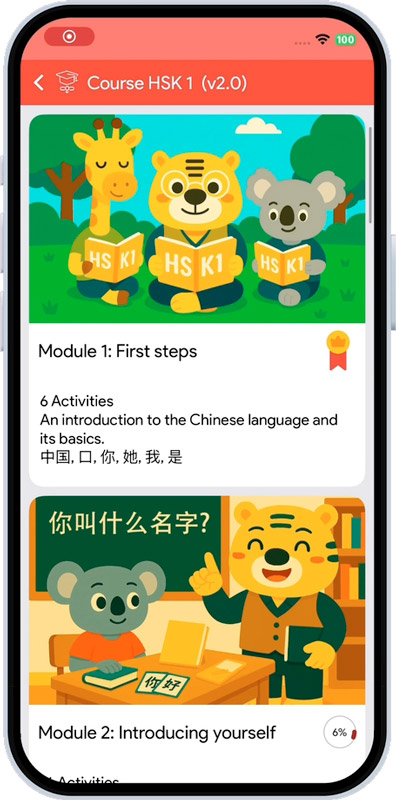
With Chinesimple by Khanji School, HSK vocabulary is taught through examples and context, so you can learn words that are useful both for the exam and for real-life situations.
FAQs
Are all these terms included in the new HSK 3.0 2026?
Yes. You will come across these words in various levels of the new HSK 3.0 2026.
Is it worth learning technological vocabulary even if it doesn’t come up until the higher levels?
Absolutely, if you are interested in technology, working online, social media or digital life in China. You don’t need to memorize everything at once, but recognizing these words can help you a lot, especially if you travel to China.
Apart from these terms, are there any more new technological terms I should know?
Yes, for example: 机器人 [jīqìrén]: robot; 二维码 [èrwéimǎ]: QR code; 网页 [wǎngyè]: web page; 电子书 [diànzǐshū]: e-book; and 数字化 [shùzìhuà]: digitalization.
Your turn 🙂
|
Free download
If you've made it this far, you're serious. Turn that momentum into real progress with Chinesimple and make every study session count.
Native audio
Games
Flashcards
Exams
Pronunciation


|
|