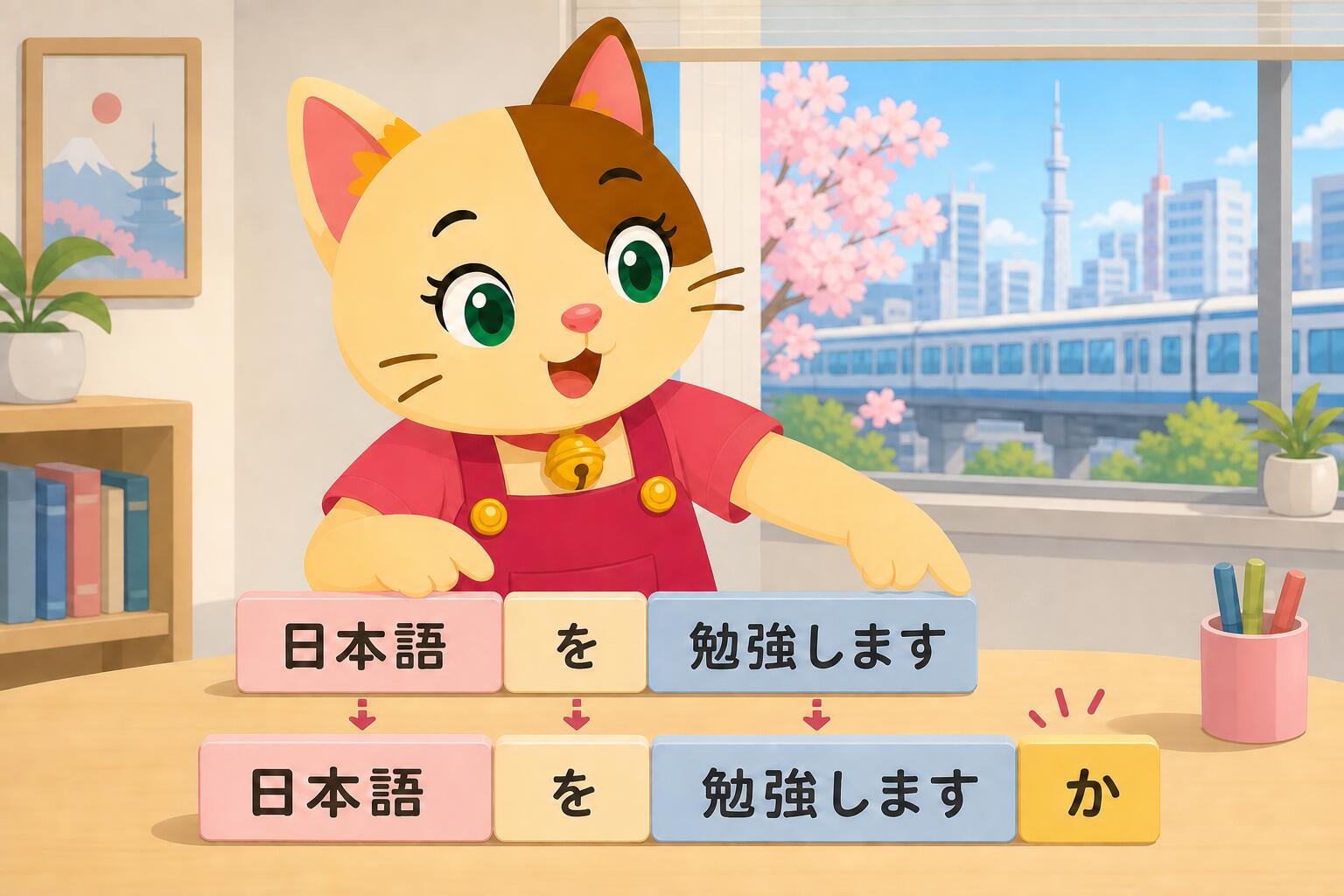
In Japanese, yes-or-no questions usually follow the same basic word order as affirmative sentences. In polite speech, you simply add the particle か 【ka】 to the end of the sentence. In casual conversation, there’s no need – your intonation will make it clear that it is a question.
What is the basic word order in Japanese?
One of the key things to know about Japanese is that the verb usually comes at the end of the sentence. As a useful rule for beginners, the most common order is topic or subject + object + verb.
Topic/subject + object + verb (SOV)
Japanese does allow you to move some elements around for emphasis, or to change the topic, but the verb generally stays at the end.
For example, a roughly literal rendering of “I study Japanese” would be “I Japanese study.”
Example
| Japanese | romaji | meaning |
|---|---|---|
| 私は日本語を勉強します。 | Watashi wa nihongo o benkyō shimasu. | I study Japanese. |
This sentence can be broken down as follows:
- 私 【watashi】: I; me.
- は 【wa】: the particle that signals the topic.
- 日本語 【nihongo】: Japanese.
- を 【o】: the particle that signals the direct object.
- 勉強します 【benkyō shimasu】: study; am studying.
How can you identify the parts of a Japanese sentence?
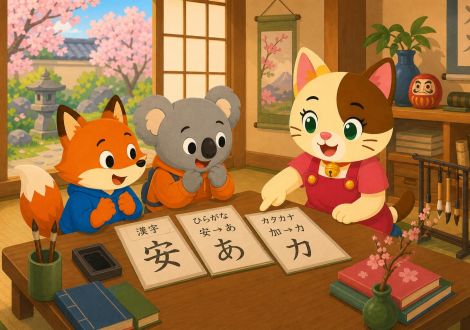
Japanese doesn’t use spaces between words. Instead, hiragana, katakana, and kanji are all combined within the same sentence. Hiragana helps identify particles and grammatical endings, while kanji often convey the core meaning of words.
- Hiragana: used mainly for endings, particles, and Japanese words written without kanji.
- Katakana: used mainly for loanwords and adapted foreign names.
- Kanji: characters of Chinese origin that represent words or concepts.
Why does です 【desu】 usually come at the end?
です 【desu】 is a polite form used to identify or describe something. It works in a similar way to the verb “to be.” In a basic sentence, it usually comes at the end, although it can be followed by sentence-final particles such as か 【ka】, ね 【ne】, or よ 【yo】.
Example
| Japanese | romaji | meaning |
|---|---|---|
| 私は日本人です。 | Watashi wa nihonjin desu. | I am Japanese. |
Here’s the breakdown:
- 私 【watashi】: I; me.
- は 【wa】: the particle that signals the topic.
- 日本人 【nihonjin】: a Japanese person.
- です 【desu】: a polite form used to identify or describe something.
How do you turn a statement into a question in Japanese?
To form a polite yes-or-no question, you just need to add か 【ka】 to the end of the sentence. The basic word order stays the same.
| type | Japanese | romaji | meaning |
|---|---|---|---|
| Affirmative sentence | 日本語を勉強します。 | Nihongo o benkyō shimasu. | I study Japanese. |
| Question | 日本語を勉強しますか。 | Nihongo o benkyō shimasu ka. | Do you study Japanese? |
Here the elements all stay the same, only with the addition of か 【ka】.
Do you always need to say “I” or “You” in Japanese?
No. In Japanese, you can often drop the subject, topic, and other elements when the context makes it clear what – or who – is being discussed. That’s why, in casual conversation, you don’t always need to say あなた 【anata】 whenever you would usually say “you” in English.
| type | Japanese | romaji | meaning |
|---|---|---|---|
| Affirmative sentence | もっと知りたいです。 | Motto shiritai desu. | I want to know more. |
| With か 【ka】 | もっと知りたいですか。 | Motto shiritai desu ka. | Do you want to know more? |
What have we learnt about the structure of Japanese questions?
- The verb usually comes at the end of the sentence.
- Polite yes-or-no questions keep the same basic word order as statements.
- The particle か 【ka】 is the main difference between a statement and a question.
- Understanding these patterns can make it much easier to master Japanese from the get-go.
With Khanji School, you learn Japanese by understanding how the language works: first you recognize the patterns, then you can go on and use them with confidence.
Frequently asked questions about Japanese word order
Do questions have a different word order from statements in Japanese?
In polite yes-or-no questions, the basic word order stays the same, you just add か 【ka】 at the end. When tackling questions with words such as “what,” “where,” or “when”, you simply place the question word in the right place within the sentence.
Why does the verb come at the end in Japanese?
Japanese sentences are usually structured like so: topic or subject + object + verb. This differs from the usual word order in English, where the verb generally comes before the object.
Is the question mark (?) used in Japanese?
Yes. It’s common in contemporary Japanese, especially in informal writing. In the polite form, か 【ka】 in itself indicates that the sentence is a question, no need for punctuation.
Do I always have to say “I” or “You” when speaking Japanese?
No. When it’s clear who you are referring to from the context, there’s no need.
Is it hard to get to grips with Japanese word order?
Japanese word order may feel unnatural at first to speakers of English, Spanish, or other languages that use a different word order. Once you get used to the verb being at the end – and yes-or-no questions using the same word order – you’ll feel much more comfortable.
|
Free download
If you've made it this far, you're serious. Turn that momentum into real progress with Chinesimple and make every study session count.
Native audio
Games
Flashcards
Exams
Pronunciation


|
|