Is Chinese really the hardest language in the world? Does it have two alphabets? Do you need to memorize thousands of characters before you can communicate? In this article, we answer these and other questions you might have before you start learning Mandarin Chinese.
Is Chinese the hardest language in the world?
You've probably heard that Chinese is the hardest language to master. In reality, language difficulty is hard to measure and really depends on the learner. Your first language, any other languages you know, and your learning experience and circumstances all play a part.
Chinese certainly has its challenges, especially when you first start working on pronunciation and writing. But you'll also find some parts may be easier than you expected, including some of its grammar.
Does Chinese really have two alphabets?
This is another common question. Chinese doesn't actually have two alphabets: its writing system uses characters, which come in different forms. The confusion usually comes from the distinction between simplified and traditional characters, or between characters and pinyin.
Let's start with Chinese characters, which come in two main forms: simplified and traditional. Many characters are identical in both.
Simplified characters are used in mainland China and Singapore, while traditional characters are used in Taiwan, Hong Kong and Macao.
When you're starting out, it makes sense to focus on the character set that best suits your goals. If you're interested in mainland China, for instance, simplified characters are the natural choice. If you plan to study or live in Taiwan, you'll want to become familiar with traditional characters.
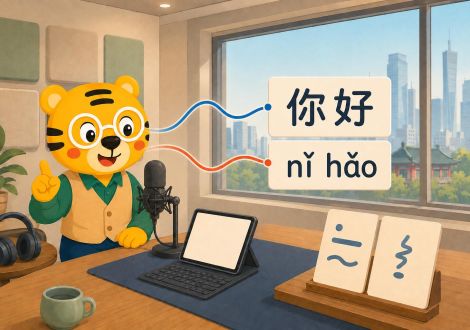
Then we have pinyin, which is separate from the character system. 拼音 [pīnyīn] uses Latin letters to represent Mandarin pronunciation. For example, 你好 is written as nǐ hǎo in pinyin and means "hello". The marks above the vowels indicate the four main tones; the neutral tone doesn't have a tone mark.
So pinyin isn't a second Chinese alphabet; it's a guide to pronunciation. Some letters represent different sounds from the ones you're used to in English, so you'll need to learn how to read them in pinyin.
What are Chinese tones?
Tones are patterns that the pitch of your voice follows as you pronounce a syllable. Standard Mandarin has four main tones and a neutral tone, and changing the tone can completely change the meaning. For example, 买 [mǎi] means "to buy", while 卖 [mài] means "to sell". Whenever you learn a new word, make sure you learn its pronunciation and tone together.
How long before I can hold a conversation in Chinese?
You can start practicing simple exchanges in your first few lessons, using set phrases to say hello, introduce yourself or ask someone's name. Striking up a conversation, understanding the replies and knowing how to respond on the spot… well, that takes a little more practice.
There's no one-size-fits-all timeline. It all depends on how much time you spend learning, how consistently you practice and how often you get to listen and speak Chinese. Instead of focusing on how many months it will take, set yourself specific goals, such as successfully ordering at a café or talking briefly about your hobbies. You don't need to master thousands of characters before you can start practicing these kinds of situations.
Do I need to learn 3,500 characters before I can communicate?
No. You don't need to know 3,500 characters to start using Chinese. You will eventually need to know a few thousand to be able to read a wide range of texts, but a character isn't necessarily a word. Many words combine two or more characters. For example, 学生 [xuésheng], "student", and 学校 [xuéxiào], "school", both contain 学 [xué], which relates to learning.
Do I need to learn to write Chinese by hand?
Not necessarily. It depends on what you want to achieve. You may recognize a word when you read it without remembering every single stroke. You can also type a message using a pinyin keyboard: enter the pinyin and select the correct characters from the options that appear. To do this accurately, you do need to be able to recognize the characters you want, though.
If your priority is to have face-to-face conversations, to travel or to communicate digitally, you don't need to spend too much time on handwriting. That said, writing characters by hand can help you better spot and memorize their components.
How much time should I spend studying Chinese?
How long is a piece of string? No set number of hours will guarantee the same results for everyone. Your skills, consistency, quality of practice and target level are all factors. Like any subject, learning Chinese takes time and effort. Just choose a routine you can stick to. As a starting point, try 20 or 30 minutes a day. If you prefer a weekly 90-minute class, you can refresh your memory with short review sessions between lessons.
|
Free download
If you've made it this far, you're serious. Turn that momentum into real progress with Chinesimple and make every study session count.
Native audio
Games
Flashcards
Exams
Pronunciation


|
|