In Korea, a baby's first birthday is a big day for the whole family, full of joy, well wishes, and, of course, plenty of photos to look back on. One of the most fun traditions is the doljabi (돌잡이), when a baby picks an object that hints at what their future might hold.
To see where this custom fits in, let's start with the celebration itself: the doljanchi (돌잔치).
What is a doljanchi, and why are first birthdays celebrated?
In Korea, there is a specific word for a baby's first birthday party: doljanchi (돌잔치). The word dol (돌) refers to the first birthday, and janchi (잔치) means a party or feast.
Before modern medicine, many babies didn't live to see their first birthday. So, turning one was a really big reason to celebrate, and the doljanchi (돌잔치) became a special occasion to celebrate the baby's growth and wish them a long, happy, healthy life. Traditionally, relatives and neighbors got together to share food and celebrate.
Guests often bring gifts for the baby, too. One of the most traditional is a gold ring, which symbolizes a healthy, happy future.
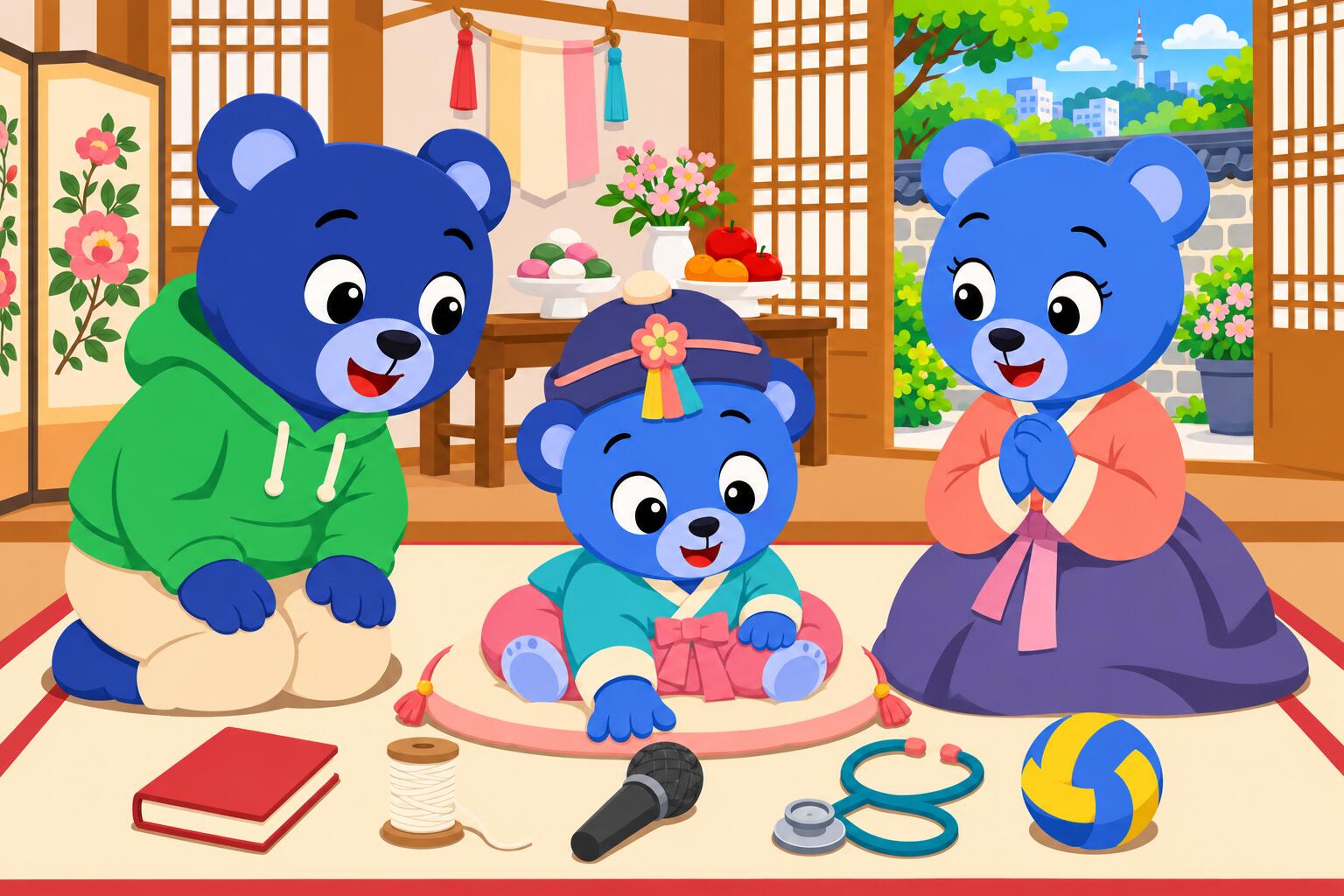
These days, no two parties look quite the same. Some families go all out at restaurants or special venues, while others prefer a smaller get-together at home. The baby often wears traditional Korean clothing called a hanbok (한복).
One part of the celebration tends to steal the show, however, and that is the doljabi (돌잡이).
What is a doljabi?
The doljabi (돌잡이) takes place during the doljanchi. The family sets out several objects in front of the baby and lets them pick whichever most catches their eye.
Traditionally, the baby's choice is said to give a glimpse into their future: what kind of person they'll become or what they'll do for a living when they grow up.
Of course, the object they pick doesn't actually decide their future. It's a nice symbolic way for the family to share their hopes for the little one.
Every object has its own meaning, and finding out which one the baby goes for is one of the most fun parts of the party.
What do the objects in a doljabi mean?
The objects vary from family to family and have changed over time. Some represent traditional well wishes, like a long life or prosperity, while others reflect modern careers.
- Money: Stands for wealth and prosperity. If the baby picks this object, the family can imagine them growing up to lead a prosperous life.
- Yarn: Represents a long, healthy life. It's one of the best-known traditional symbols.
- A book, writing brush, or pencil: Stands for knowledge, learning, and doing well at school.
- Rice: Symbolizes abundance and the hope that the child will always have everything they need.
- A stethoscope: Represents medicine and the possibility that the baby might become a doctor.
- A microphone: Can point to a future as a singer or performer.
- A ball: Represents sports and the possibility of becoming an athlete.
- A computer mouse: Stands for the world of technology and computing.
What objects did people use in the past?
The custom spread during the Joseon period, from the royal household to other families. Objects laid out for the baby included rice, yarn, books, writing brushes, bows, and arrows.
Some of those objects, like rice, yarn, and writing brushes, are still used today. At some parties, items like bows and arrows have made way for more modern choices, like soccer balls, stethoscopes, or computer mice.
There's no set list of objects for a doljabi. Each family can pick whatever they like best or what best represents their hopes for the baby.
How do families celebrate the doljanchi and doljabi today?
The doljabi is still a big part of the doljanchi. It's less about trying to predict the future and more about wishing the baby well, celebrating their first birthday, and making special family memories.
Frequently asked questions about doljanchi and doljabi
What's the difference between doljanchi and doljabi?
The doljanchi is the first birthday party. The doljabi is the part of the party when the baby picks an object.
Why is the first birthday important in Korea?
In the past, many babies didn't live to see the age of one. Reaching that first birthday was a reason to celebrate and a chance to wish the baby a long and healthy life.
Do families still celebrate doljanchi in Korea?
Yes. Some families throw big parties, while others prefer smaller celebrations at home.
|
Free download
If you've made it this far, you're serious. Turn that momentum into real progress with Chinesimple and make every study session count.
Native audio
Games
Flashcards
Exams
Pronunciation


|
|